Goes with Everything Cowl

 Goes  with  Everything  Cowl

Hello fellow knitters and crocheters, welcome to my first blog post of 2021. It’s common to write about one’s knitting and crocheting goals for the year, but I will skip all that. Instead, I will write about how I knitted the Goes with Everything Cowl. I chose this name for the cowl because the yarn colorway seems to go with everything I have in my wardrobe. I purchased this yarn (one skein) a couple of years ago on a wonderful summer vacation trip. This cowl was a quick and simple knit and I’m satisfied with how it turned out. I’ll be wearing it quite a bit during this frigidly cold winter.
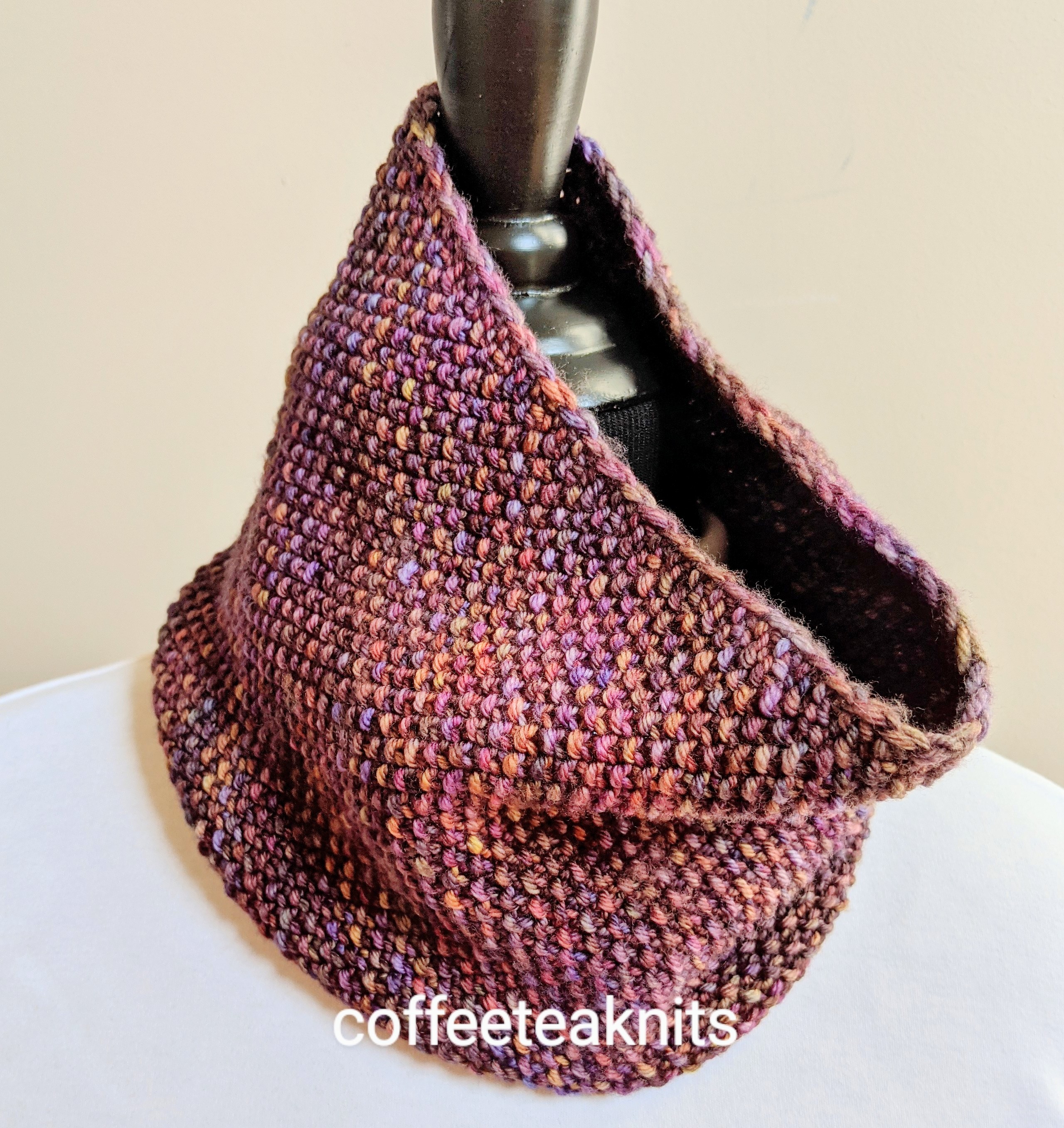
The cowl is knitted flat in a rectangle from one corner to another. The two shorter sides of the rectangle are then joined to make a warm and comfortable circular cowl. You begin with casting on one stitch and increase two stitches every other row till the desired width is reached. The cowl is then worked on for the desired length with no net increase. Lastly the cowl is decreased two stitches every other row till one stitch is left on the needle. The shorter sides of the knitted rectangle are then joined together using the zigzag crochet join method.

Goes with Everything Cowl Pattern (text and images for personal use only):
Yarn: Malabrigo Yarn – Rios in the RIO877 (Queguay) colorway
Knitting Needles: US #7
Crochet hook: US size 7 or 4.5 mm crochet hook
Gauge: 16 stitches/ 4 inches (this pattern is generic so gauge not so critical)
Abbreviations:

  • K: Knit
  • P: Purl
  • Kfb: Knit front and back (knit one stitch first in the front and then knit the same stitch in the back before slipping it off the left needle – 1 stitch increase)
  • K2tog: Knit the first two stitches together on the left needle (1 stitch decrease)
  • pm: place marker
  • rm: remove marker
  • sm: slip marker
  • wyif: with yarn in front
  • RS: right side
  • WS: wrong side

The seed stitch pattern:
Row 1 (RS): *K1, P1*; repeat from *…* to end of the row
Row 2 (WS): *P1, K1*; repeat  from *…* to end of the row
*Knit in seed stitch pattern: Knit the purl stitches and purl the knit stitches

With a size US #7 knitting needle cast on 1 stitch with this yarn

Increase Rows:

  • Row 1 (RS): Kfb and turn to the WS row
  • Row 2 (WS): K2
  • Row 3 (RS): Kfb, Kfb
  • Row 4 (WS): K1, pm, K2, pm, wyif S1
  • Row 5 (RS): K1, sm, Kfb, Kfb, sm, wyif S1. Place a removable stitch marker for the RS row.
  • Row 6 (WS): K1, sm, K1, P1, K2, sm, wyif S1
  • Row 7 (RS): K1, sm, Kfb, K1, P1, Kfb, sm, wyif S1
  • Row 8 (WS): K1, sm, K1, [K1, P1] 2x, K1, sm, wyif S1
  • Row 9 (RS): K1, sm, Kfb, [knit in seed stitch pattern*] till 1 stitch before marker, Kfb, sm, wyif S1
  • Row 10 (WS): K1, sm, K1, [knit in seed stitch pattern*] till 1 stitch before marker, K1, wyif S1

Repeat rows 9 and 10 till the number of stitches for the preferred cowl width is reached. The width for this cowl is about 7.5 inches.

Length increase Rows:

  • Row 1 (RS): K1, sm, Kfb, [knit in seed stitch pattern*] till 2 stitches before marker, K2tog, sm, wyif S1
  • Row 2 (WS): K1, sm, K1, [knit in seed stitch pattern*] till 1 stitch before marker, K1, sm, wyif S1

Repeat these two rows till desired length is reached. The length for this cowl is about 19.5 inches.

Decrease Rows:

  • Row 1 (RS): K1, sm, K2tog, [knit in seed stitch pattern*] till 2 stitches before marker, K2tog, sm, wyif S1
  • Row 2 (WS): K1, sm, K1, [knit in seed stitch pattern*] till 1 stitch before marker, K1, sm, wyif  S1

Repeat Rows 1 and 2 till 6 stitches left on the needle ending on the WS row

  • RS row: K1, sm, K2tog, K2tog, sm, wyif S1
  • WS row: K1, rm, K2, rm, wyif S1 (do not remove the RS removable marker)
  • RS row: K2tog, K2tog
  • WS row: Bind off (hold the remaining stitch with a removable stitch marker)

Crochet join (optional):

Insert a size 7 or 4.5 mm crochet hook in the remaining stitch, remove the stitch marker, chain one, and align the two shorter sides of the knitted rectangle together on the RS. Use the zigzag crochet join method to join the two sides together (several online video tutorials are available for this crochet join method).

Alternately, the two sides can be joined with any other join method of choice.

Weave in the ends, wash and block cowl.


Stay warm and stay safe


~coffeeteaknits.com

2020

2020 has been quite a year hasn’t it? It will not be forgotten any time soon. The coronavirus pandemic with the stay at home order, minimal social gatherings, travel restrictions, ongoing family and personal health issues, hurricane, hailstorm, power outage, milestones and events not celebrated etc. pretty much describes 2020 for me. 

And yet I am grateful for all the positive things that did happen this year. Births happened, weddings happened, culinary adventures happened, bread baking happened, gardening happened, neighborly and community kindness happened, knitting and crafting happened, and the courage to design and publish knitting patterns happened

Free patterns available on my July 2020 to November 2020 posts
Some more of my makes in 2020

Stay safe and warm wishes this holiday season!


~coffeeteaknits.com

A Corner to Corner Dishcloth

Corner to Corner Dishcloth

Corner to Corner Dishcloth

Corner to corner knitting is another technique that can be used to knit square dishcloths, blankets etc. I like this technique because it’s worked flat and starts with a cast on of just 1 stitch. That 1 stitch through a series of increases and decreases ends in a square dishcloth or a blanket. The dishcloth pattern below is my version of the corner to corner knitting technique using the seed stitch pattern.

The Corner to Corner Dishcloth Pattern (text and images for personal use only):

Yarn: Lily Sugar’n Cream in Colorways: Potpourri Ombre and Country Red
Knitting Needles: US #7
Crochet hook: US size 7 or 4.5 mm crochet hook
Gauge: Not needed for this project
Abbreviations:

  • K: Knit
  • P: Purl
  • Kfb: Knit front and back (knit one stitch first in the front and then knit the same stitch in the back before slipping it off the left needle – 1 stitch increase) 
  • K2tog: Knit the first two stitches together on the left needle (1 stitch decrease)
  • ssk: slip slip knit (slip 2 stitches to right hand needle then insert the left needle in front of the two slipped stitches and knit them together)
  • pm: place marker
  • rm: remove marker
  • sm: slip marker
  • wyif: with yarn in front
  • RS: right side
  • WS: wrong side

The seed stitch pattern:
Row 1 (RS): *K1, P1*; repeat from *…* to end of the row
Row 2 (WS): *P1, K1*; repeat  from *…* to end of the row
*Knit in seed stitch pattern: Knit the purl stitches and purl the knit stitches

With a size US #7 knitting needle cast on 1 stitch with the Potpourri Ombre colorway.

Increase Rows:

  • Row 1 (RS): Kfb and turn to the WS row
  • Row 2 (WS): K2
  • Row 3 (RS): Kfb, Kfb
  • Row 4 (WS): K1, pm, K2, pm, wyif S1
  • Row 5 (RS): K1, sm, Kfb, Kfb, sm, wyif S1. Place a removable stitch marker for the RS row. 
  • Row 6 (WS): K1, sm, K1, P1, K2, sm, wyif S1
  • Row 7 (RS): K1, sm, Kfb, K1, P1, Kfb, sm, wyif S1
  • Row 8 (WS): K1, sm, K1, [K1, P1] 2x, K1, sm, wyif S1
  • Row 9 (RS): K1, sm, Kfb, [knit in seed stitch pattern*] till 1 stitch before marker, Kfb, sm, wyif S1
  • Row (WS): K1, sm, K1, [knit in seed stitch pattern] till 1 stitch before marker, K1, wyif S1

Repeat rows 9 and 10 till the number of stitches for the preferred dishcloth size is reached.

Transition Rows:

  • Row 1 (RS): K1, sm, K1, [knit in seed stitch pattern] till 1 stitch before marker, K1, sm, wyif S1
  • Row 2 (WS): K1, sm, K1, [knit in seed stitch pattern] till 1 stitch before marker, K1, sm, wyif S1

Decrease Rows:

  • Row 1 (RS): K1, sm, K2tog, [knit in seed stitch pattern] till 2 stitches before marker, ssk, sm, wyif S1
  • Row 2 (WS): K1, sm, K1, [knit in seed stitch pattern] till 1 stitch before marker, K1, sm, wyif  S1
  • Repeat Rows 1 and 2 till 6 stitches left on the needle on the WS row
  • RS row: K1, sm, K2tog, ssk, sm, wyif S1
  • WS row: K1, rm, K2, rm, wyif S1
  • RS row: K2tog, ssk
  • WS row: Bind off

Wash and block dishcloth.

Crochet a single crochet border edging around the dishcloth in the Country Red colorway with a Size 7 or 4.5 mm crochet hook.

Weave in the ends.


~coffeeteaknits.com

The Increases and Decreases Cowl

The Increases and Decreases Cowl

Last year, I purchased a single skein of the Lion Brand ZZ Twist yarn in the Periwinkle colorway.  I wanted to see how this yarn spun with a “Z ” twist would knit up. I knit this Increases and Decreases Cowl (free pattern below) using a blanket rib knit stitch pattern. This stitch pattern is a two round pattern where all the stitches are doubled in the first round, and then decreased to the original number of stitches in the second round.

The Increases and Decreases Cowl Pattern (text and images for personal use only):

Yarn: Lion Brand ZZ Twist yarn in the Periwinkle colorway
Circular Knitting Needles: US #8 and US #9
Knitting Needle: US #10 for cast on
Gauge: 16 stitches / 4 inches in blanket rib stitch pattern with US #8 needles
Abbreviations:

With a circular US #10 needle, cast on 85 stitches using the long tail cast on method.
Sip all the stitches to a circular US #9 needle, place a BOR marker, join round* (make sure the stitches are not twisted) by knitting as follows:

  • Round 1: K1, *Kfb*; repeat from *…* till one stitch before the BOR marker, K1, slip BOR marker.
  • Round 2: K1, P2tog, *K2tog, P2tog*; repeat from *…* till one stitch before BOR marker, K1, slip BOR marker.

Repeat Rounds 1 and 2 –  9 more times.
Switch to circular US #8 needles and knit Rounds 1 and 2 until the desired cowl length is reached. 
Bind off in pattern ending in Round 2.
Wash and weave in the ends.


I liked the stitch definition and drape of this yarn. I think the blanket rib stitch pattern with this “Z” twisted yarn makes it look more like a crochet stitch rather than a knit stitch. This yarn is also very soft and smooth to work with, budget friendly, machine washable, and wool free. My knitting experience was very satisfying with this yarn and I plan to continue knitting or crocheting more projects with it.

How has your knitting experience been with the ZZ Twist yarn? 


*Tutorial Series: How to Join Round


~coffeeteaknits.com

Striped Spiral Hotpad/Trivet

Striped Spiral Hotpad/Trivet


I knitted this Striped Spiral Hotpad/Trivet in the round with a series of decreases in a spiral towards the center. The trivet is knitted in the garter stitch pattern with 2 strands of yarn held together. The stripes in the trivet are made by alternating the two different yarn colorways for each garter ridge. I used yarn I already had in my stash from previous leftover projects so all the colorways may or may not be currently available. You can use any other yarn colorway to knit this trivet.

The Striped Spiral Hotpad/Trivet Pattern (text and photo for personal use only):

Yarn: Patons Classic Wool Worsted (Colorways: C1- Cognac Heather; C2 – Natural Mix)
Circular Knitting Needles: US #8 and US #10
Crochet hook: I/9 or 5.5 mm crochet hook
Gauge: 16 stitches / 4 inches in garter stitch pattern (although not really necessary).

Abbreviations:

  • K: Knit
  • P: Purl
  • K2tog: Knit the first two stitches on the left needle together
  • sm: slip marker
  • BOR: beginning of round
  • C1: Yarn colorway – Cognac Heather
  • C2: Yarn colorway – Natural Mix

With a circular US #10 needle, cast on 120 stitches using the long tail cast on and 2 strands of yarn C1 held together.

Slip all the stitches to a circular US #8 needle placing a marker every 20 stitches. (total of 5 markers)

Slip a BOR marker and join the round making sure the stitches are not twisted and knit the following:

  • Round 1: With 2 strands of yarn C1 held together – [Knit till 2 stitches before marker, K2tog, sm,] 5 times, knit till 2 stitch before BOR marker, K2tog, slip BOR marker.

  • Round 2: With 2 strands of yarn C1 held together – [Purl till 1 stitch before marker, K1, sm] 5 times, purl till 1 stitch before BOR marker, K1, slip BOR marker.

  • Round 3: With 2 strands of yarn C2 held together – [Knit till 2 stitches before marker, K2tog, sm] 5 times, knit till 2 stitch before BOR marker, K2tog, slip BOR marker.

  • Round 4: With 2 strands of yarn C2 held together – [Purl till 1 stitch before marker, K1, sm] 5 times, purl till 1 stitch before BOR marker, K1, slip BOR marker.

  • Repeat rounds 1 to 4 till 12 stitches remain on the needles ending with yarn C2.

  • With 2 strands of yarn C1 held together – [K2tog] (6 times) removing all markers. (6 stitches remain). 

  • Cut yarn and with a darning needle thread tail through the 6 stitches, pull tight and fasten off.

  • Starting at the beginning of the cast on, single crochet with hook size I/9 all around the trivet with 2 strands of yarn C2 held together

  • Weave in the ends, wash and block the trivet.

For a smaller trivet, cast on any multiple of 6


~coffeeteaknits.com