To Knit an Impromptu Custom Sweater


Knitting an impromptu custom top down sweater is much like an unplanned journey to me. The final destination is known but the path taken and the process to get there is not clear.

The cotton yarn for this project was meant for a weaving project that didn’t happen.

I quickly cast on enough stitches to begin a custom top down raglan sleeved cardigan. Since both the yarn were variegated alternating them in stripes to prevent too much color pooling seemed like the way to go.

Several rows in I changed direction and decided to knit a pullover instead of a cardigan. So some more stitches were cast on, the round joined and the journey towards a top down pullover began.

The journey to a completed sweater body and sleeves went pretty smoothly. I washed, blocked and photographed the sweater.

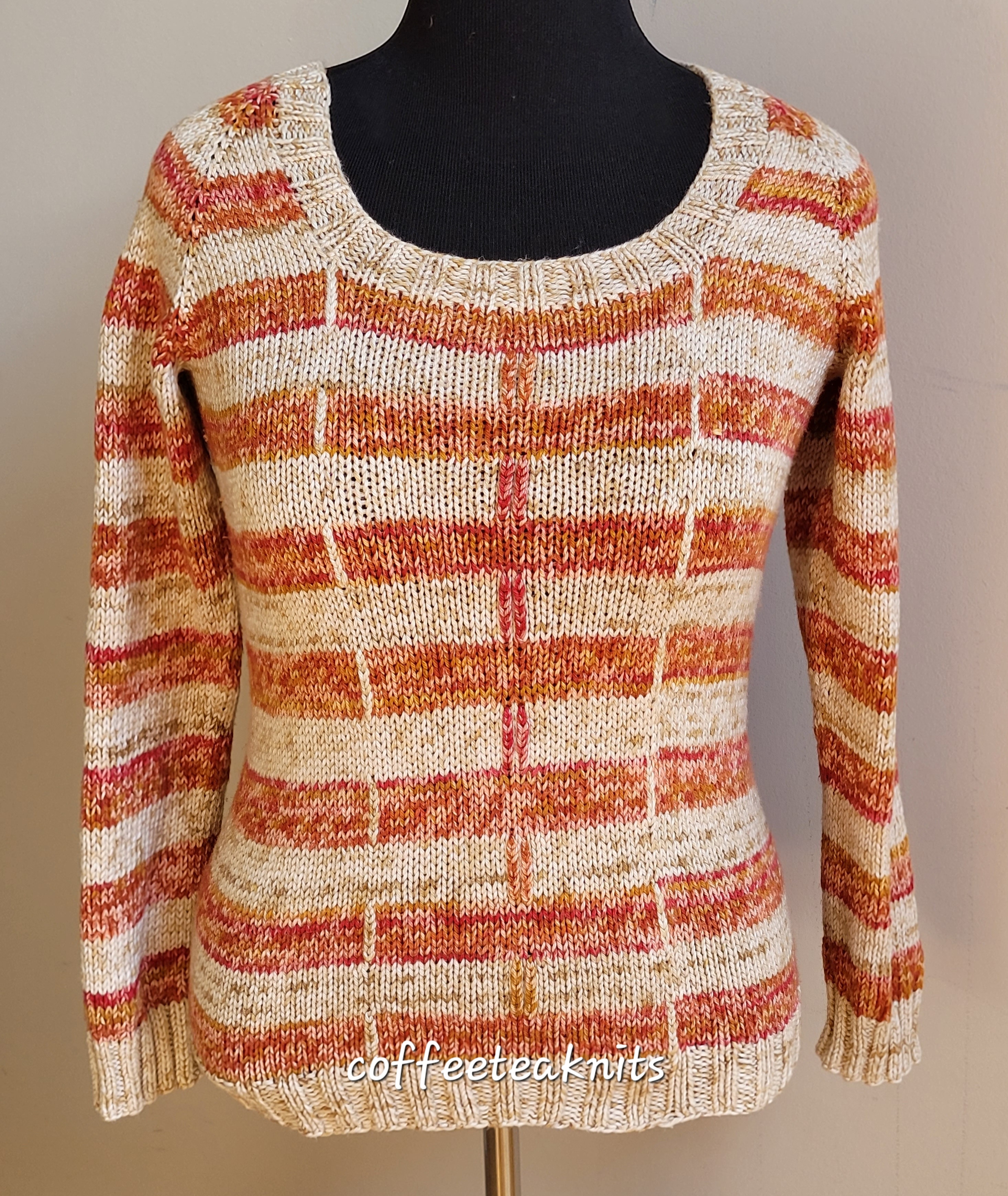
The finished pullover:


Those uneven horizontal stripes (arrows) at the beginning of round where the yarn for the stripe pattern changed were pretty noticeable to me. I had to get some help from the crochet duplicate stitch pattern. The crochet duplicate stitch placed vertically fortunately made the uneven horizontal stripes less noticeable.

The finished impromptu custom sweater was not at all how I visualized it to be when I first cast on some stitches for a top down raglan sleeved sweater.

Reaching my destination of a finished sweater took much longer than I had anticipated. I had expected a journey of simple stockinette and 2 x 2 rib stitch patterns but then had to add a more complicated crochet duplicate stitch pattern in the opposite direction.

Knitting this impromptu sweater was quite a journey for me. I am pleasantly surprised and satisfied with how this unplanned sweater turned out.

Now having reached my destination I look forward to a chance to wear this impromptu pullover.


~coffeeteaknits.com

Spring Is In The Air Dishcloth Pattern


Somehow the birds chirping, the bright blue sky, the showers, warmer days, new leaves on trees and the vibrant Spring flowers refresh and lighten my mood. I get motivated to declutter, clean and of course start new knitting projects appropriate for Spring and Summer. As the weather gets warmer, I start knitting more with cotton yarn. Spring is in the Air Dishcloth reflects this cheerfulness that comes with warm weather. The dishcloth was knit in the linen stitch pattern with two different colors of cotton worsted yarn. It was knit in the round moving towards the center through a series of decreases every other round. The knitting technique for this dishcloth is similar to The Toward Center Mitered Dishcloth but was knit alternating two different colors of the cotton worsted yarn in each round.

Spring Is In The Air Dishcloth Pattern (text and images for personal use only)

Yarn: Any Cotton Worsted Yarn in 2 different colorways – I used some Lily Sugar’n Cream yarn in White (Colorway 2) and Yellow (Colorway 1)
Knitting Needles: US #10 for cast on and US #9 circular needles to knit the dishcloth
Crochet hook: US size H- 8 or 5.0 mm crochet hook
Tapestry Needle to weave in ends
Gauge: 4 stitches/inch but is not needed for this project
Abbreviations:

  • K: Knit
  • P: Purl
  • K2tog: Knit the first two stitches on the left needle together
  • pm: place marker
  • sm: slip marker
  • BOR: beginning of round
  • wyib: with working yarn in the back
  • wyif: with working yarn in front
  • *…*: pattern repeats within a section
  • […]: repeat pattern for each of the 4 sections within brackets

With US #10 knitting needles cast on 140 stitches with Colorway 2 (White) yarn using the long tail cast on or the thumb method.
Transfer all stitches to a 16 inch US #9 circular needles, place a BOR marker and join round to knit the following making sure the stitches are not twisted. 

  • Round 1: With Colorway 1 yarn (Yellow): [slip 1 stitch wyib, pm, K2tog, (*K1, slip1 wyif* repeat *…* 15 more times), K2tog, pm] repeat […] 2 more times, slip 1 stitch wyib, pm, K2tog, (*K1, slip1 wyif* repeat *…* 15 more times), K2tog, slip BOR marker
  • Round 2: With Colorway 2 yarn (White): [K1, sm, *K1, slip 1 wyif* repeat *…* till marker, sm] repeat […] 2 more times, K1, sm, *K1, slip 1 wyif* repeat *…* till BOR marker, slip BOR marker  
  • Round 3: With Colorway 1 yarn (Yellow): [slip 1 stitch wyib, sm, K2tog, *slip1 wyif, K1* repeat *…* till 2 stitches before marker, K2tog, sm] repeat […] 2 more times, slip 1 stitch wyib, pm, K2tog, *slip 1 wyif, K1* repeat *…* till 2 stitches before BOR marker, K2tog, slip BOR marker 
  • Round 4: With Colorway 2 yarn (White): [K1, sm, *slip 1 wyif, K1* repeat *…* till marker, sm] repeat […] 2 more times, K1, sm, *slip 1 wyif, K1* repeat *…* till BOR marker, slip BOR marker 
  • Round 5: With Colorway 1 yarn (Yellow): [slip 1 stitch wyib, sm, K2tog, *K1, slip 1 wyif* repeat *…* till 2 stitches before marker, K2tog, sm] repeat […] 2 more times, slip 1 stitch wyib, pm, K2tog, *K1, slip 1 wyif* repeat *…* till 2 stitches before BOR marker, K2tog, slip BOR marker 
  • Round 6: With Colorway 2 yarn (White): [K1, sm, *K1, slip1 wyif* repeat *…* till marker, sm] repeat […] 2 more times, K1, sm, *K1, slip 1 wyif* repeat *…* till BOR marker, slip BOR marker 

Repeat Rounds 3 – 6, six more times. There are 20 stitches left on the needles after these repeats.

  • Round 31: Colorway 1 (Yellow): [slip 1 stitch wyib, sm K2tog, K2tog, sm], repeat […] 2 more times, slip 1 stitch wyib, sm K2tog, K2tog, slip BOR marker 
  • Round 32: Colorway 2 (White): [K1, sm, slip 1 wyif, K1, sm], repeat […] 2 more times, K1, sm, slip1 wyif, K1, slip BOR marker
  • Round 33: Colorway 1 (Yellow) : [slip 1 stitch wyib, sm, K2tog, sm], repeat […] 2 more times, slip 1 stitch wyib, sm, K2tog, slip BOR marker
  • Round 34: Colorway 2 (White): Knit all stitches removing all markers except the BOR marker (8 stitches remaining)

Cut the working yarn and pull it through a tapestry needle. Insert the tapestry needle through the remaining eight stitches and pull them tight to close the gap. Secure yarn on the reverse side of the dishcloth.

Single Crochet Edging and hanging loop:

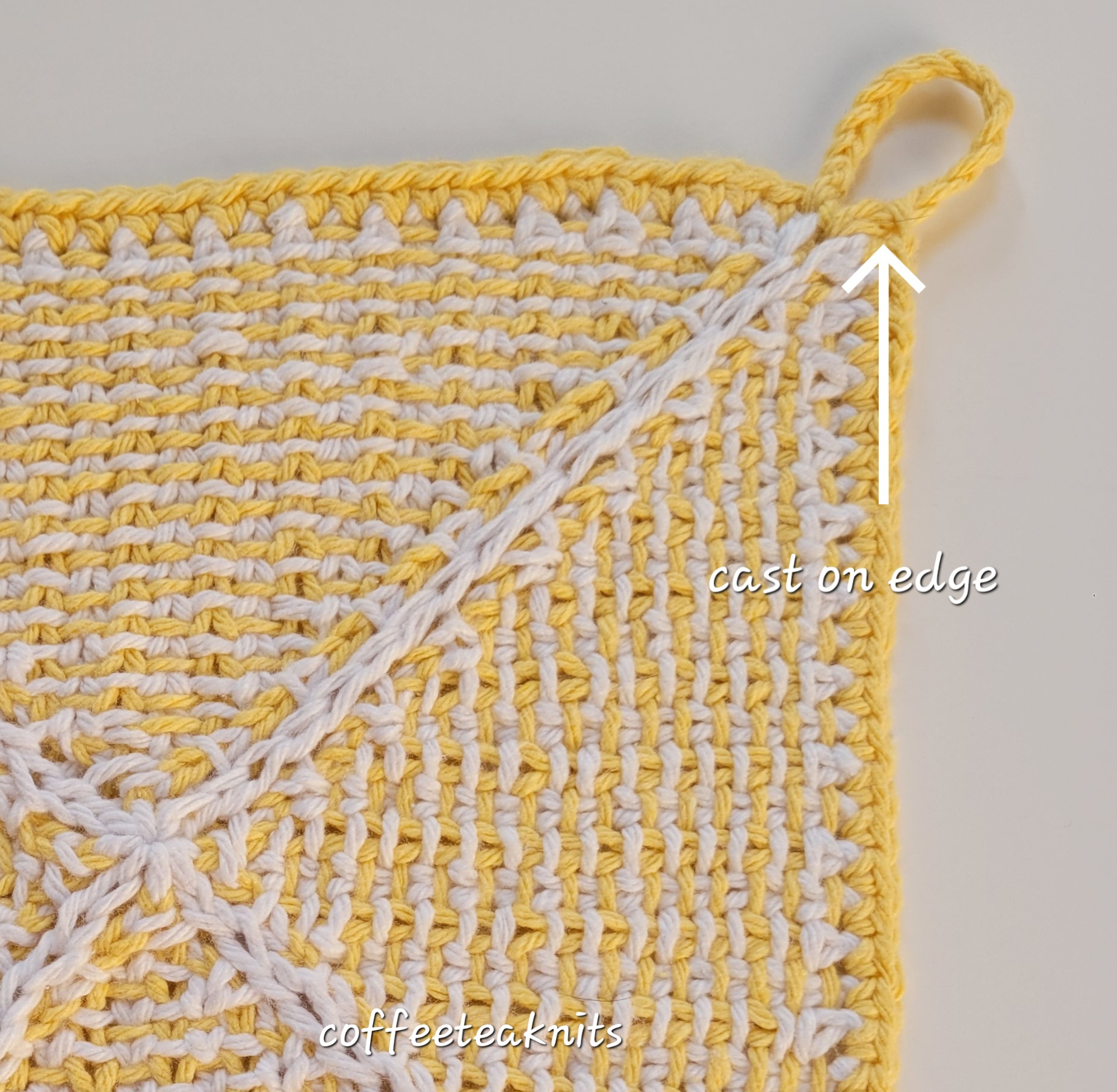
  • Crochet edging: Starting at the cast on edge to the right of the center knit stitch (see picture below), pick up and single crochet with H-8 (5.0 mm) crochet hook all around the dishcloth edge with Colorway 1 (yellow) yarn. Slip stitch into the first single crochet border stitch and crochet 12 to 15 chain stitches. Slip stitch into the single crochet stitch on the other side of the center knit stitch.

crochetborder

  • Weave in the ends
  • Wash and block the dishcloth

Enjoy your knitting this Spring!


~coffeeteaknits.com

The Nostalgic Wrap Pattern

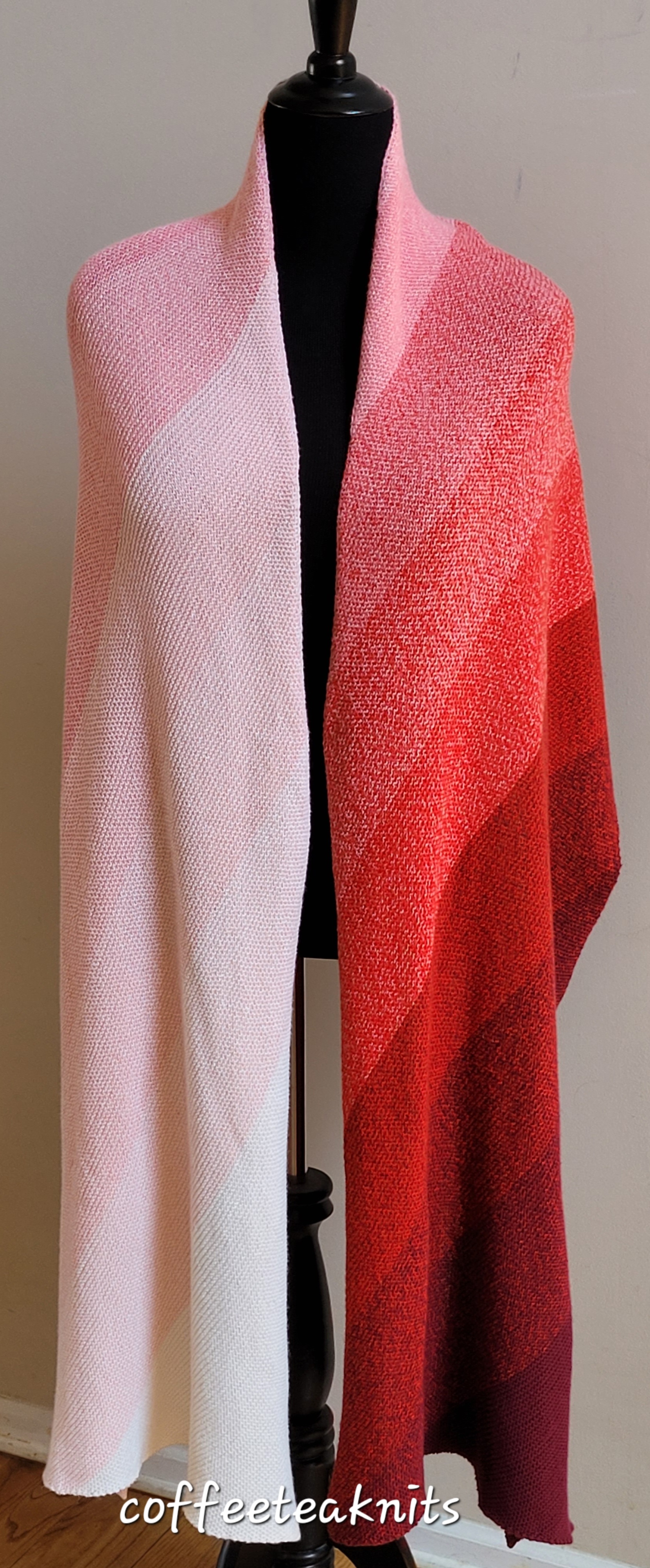
The Nostalgic Wrap was knit for the opportunities and the arts and crafts stores that are no longer there. The wrap is knit with a cotton yarn that I purchased in the beginning of 2020 at A. C. Moore that closed its stores later that year. I spent many hours in that store exploring and learning about the different types of yarn and yarn brands. It was where knitting and yarn became a serious hobby and craft for me. A. C. Moore was my window at a time when several doors had closed for me. It is much missed by me.

The Nostalgic Wrap is knit using the same cotton yarn as in The Harmony Wrap that I knit in September 2020. The colors of the yarn are different in the two wraps but each cake of this yarn has a gradient of 14 different colors. The yarn has been discontinued but a substitute yarn can be found on Yarn Sub. Both wraps are knit using the bias knitting technique with a 1 stitch cast on (tutorials for bias knitting technique can be found on YouTube). The wrap is knit using the garter stitch pattern. Although knitting the Nostalgic Wrap took a long time, I found it both a very relaxing and meditative knit. The wrap can be easily customized to shorter length or wider width if preferred. The Nostalgic Wrap is about 18 inches wide (without stretching) and about 96 inches in length.

The Nostalgic Wrap Pattern (text and images for personal use only)

Yarn: Stitch Studio by Nicole Cotton Colors in Purple Red Pink Colorway (2 yarn cakes – 250 grams each used for this pattern). There are 14 different colors in a gradient for each cake which are marked as 1 to 14
Knitting Needles: US #2 or 2.75 mm knitting needles
Gauge: 26 stitches/ 4 inches (this pattern is generic so gauge not so critical)
Abbreviations:

  • K: Knit
  • P: Purl
  • Kfb: Knit front and back (knit one stitch first in the front and then knit the same stitch in the back before slipping it off the left needle – 1 stitch increase)
  • K2tog: Knit the first two stitches together on the left needle (1 stitch decrease)
  • SSK: slip slip knit (slip 2 stitches to right hand needle then insert the left needle in front of the two slipped stitches and knit them together
  • RS: right side
  • WS: wrong side
  • garter ridge – RS and WS row in knit stitch pattern (2 knitted rows)

Cast on 1 stitch with US #2 needles with color 1 (the first color in the center pull gradient yarn)

Increase Section:
Row 1 (RS): color 1 – Kfb
Row 2 (WS): color 1 – K2
Row 3 (RS): color 1 – Kfb, Kfb
Row 4 (WS): color 1 – K4
Row 5 (RS): color 1 – Kfb, knit to 1 stitch before last, Kfb
Row 6 (WS): color 1 – Knit all the stitches
Repeat Rows 5 and 6 (with color 1) till 146  stitches on the needles. 
Change to Color 2 and repeat rows 5 and 6 till 208 stitches on the needles (the length can be extended if preferred with the next color in the gradient)

Length Increase Section (garter ridges):
Row 1 (RS): Color 3 – Kfb, knit till 2 stitches left, K2tog.
Row 2 (WS): Color 3 –  Knit all the stitches
Repeat Rows 1 and 2 for twenty five more garter ridges (more or less garter ridges if preferred). 
Change to Color 4 and repeat rows 1 and 2 for a total of 26 garter ridges
Change to Color 5 and repeat rows 1 and 2 for a total of 26 garter ridges
Change to Color 6 and repeat rows 1 and 2 for a total of 26 garter ridges
Change to Color 7 and repeat rows 1 and 2 for a total of 26 garter ridges
Change to Color 8 and repeat rows 1 and 2 for a total of 26 garter ridges
Change to Color 9 and repeat rows 1 and 2 for a total of 26 garter ridges
Change to Color 10 and repeat rows 1 and 2 for a total of 26 garter ridges
Change to Color 11 and repeat rows 1 and 2 for a total of 26 garter ridges
Change to Color 12 and repeat rows 1 and 2 for a total of 26 garter ridges

Decrease Section:
Change to Color 13 and knit as follows:
Row 1 (RS): SSK, knit till 2 stitches left, K2tog
Row 2 (WS): Knit all the stitches
Repeat Rows 1 and 2 for thirty more garter ridges. 
Change to Color 14 and knit Rows 1 and 2 till four stitches left on the needle.
Row (RS): SSK, K2tog
Row (WS): Knit 2 stitches,
Last Row (RS): SSK and pull working yarn through
Weave in the ends, wash and block the Nostalgic Wrap.


~coffeeteaknits.com

The Warp and Weft Floats in Weaving

In the past year I’ve been exploring different variations in plain weaving on a rigid heddle loom. Rigid heddle loom weaving consists of warp and weft threads (or yarn). The warp thread is held vertically (lengthwise) under tension while the weft thread is passed horizontally through the warp threads by the weaver.

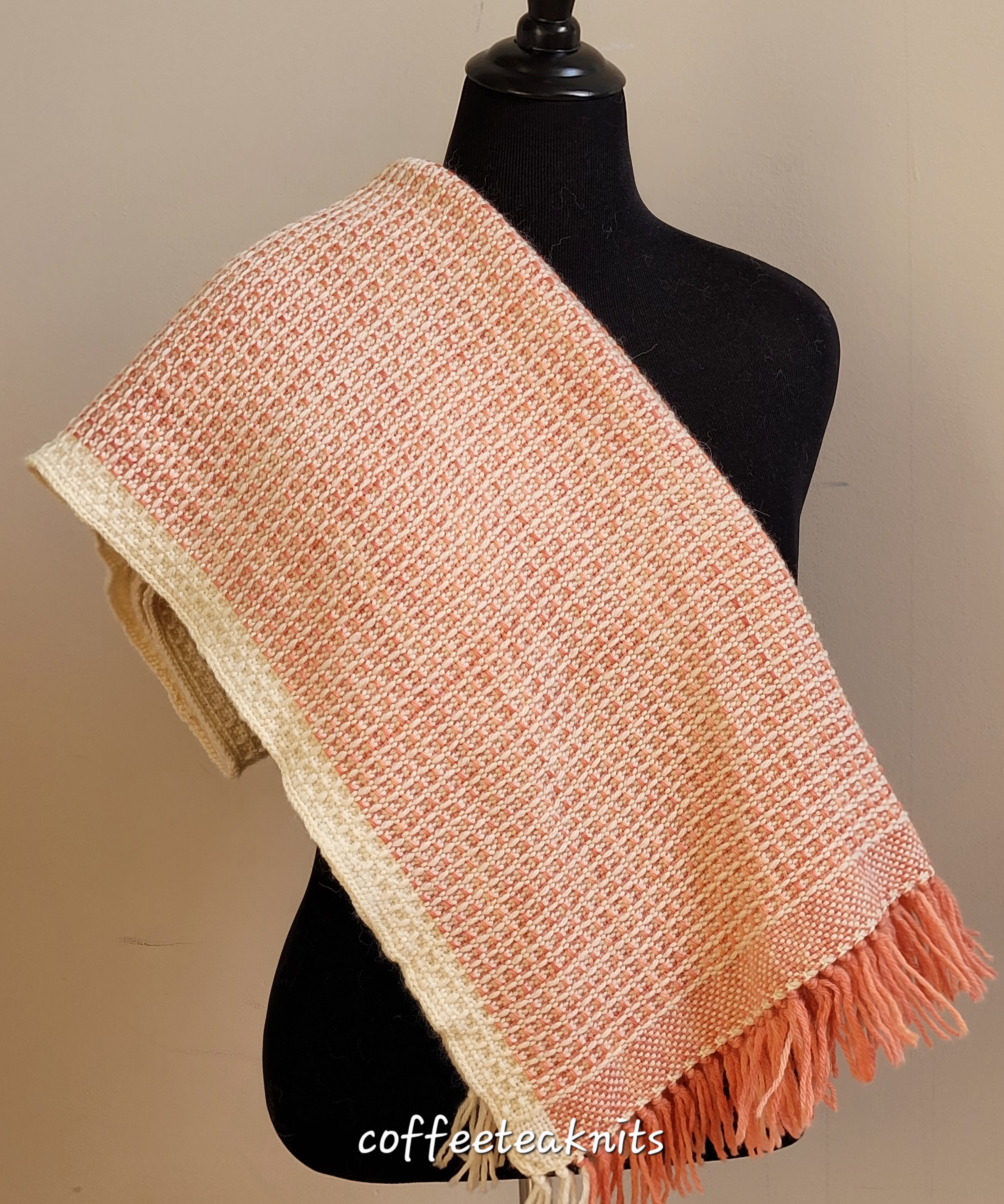
One way to add some texture to a plain weave is to have warp, weft or both warp and weft floats. Pictured below is a woven scarf and a woven wrap/shawl that has both warp and weft floats. The scarf was woven with same cotton yarn for both its warp and weft. The wrap/shawl was woven with two different colors of wool yarn for its warp and weft.

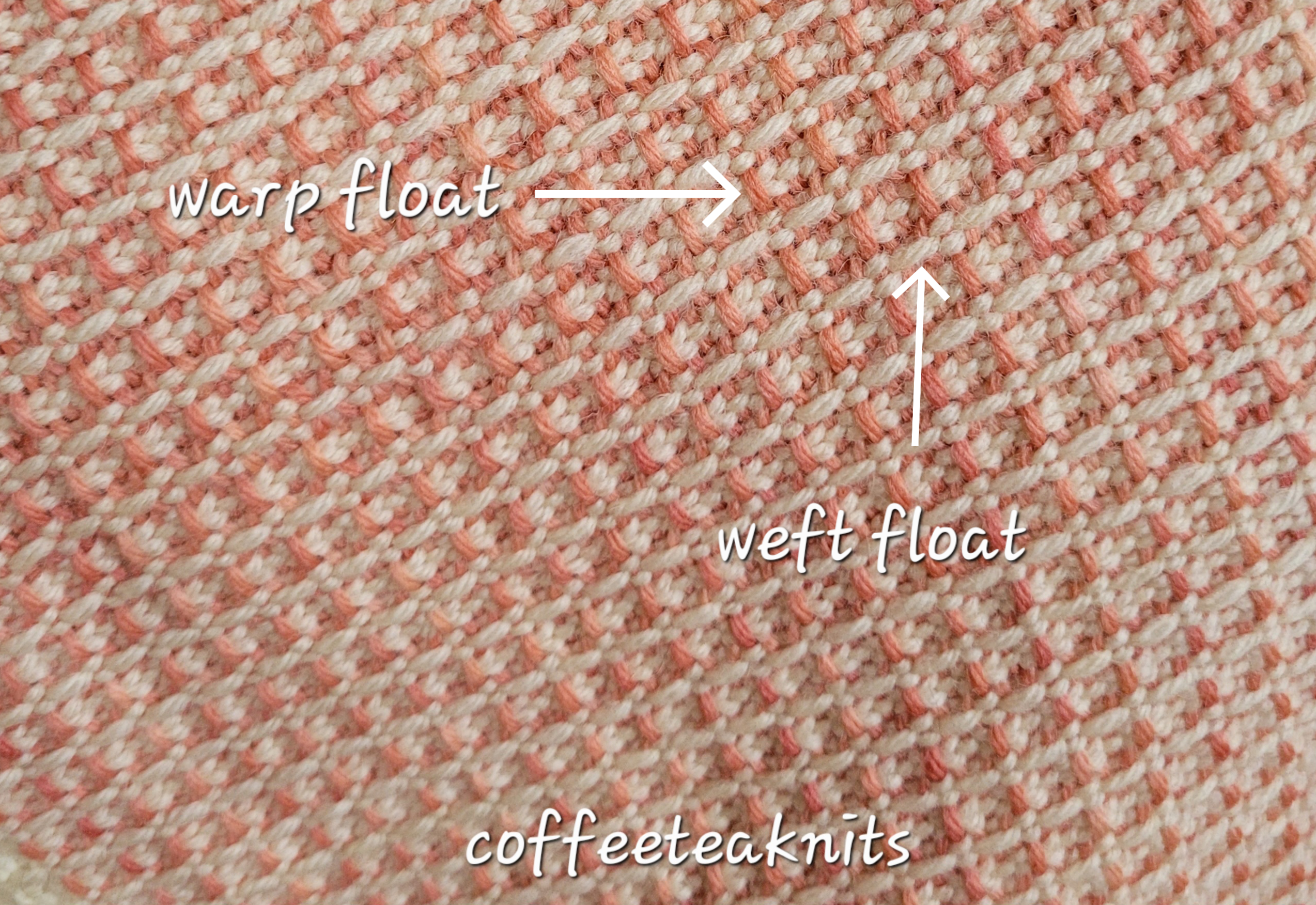
Floats are skips (not passed through) in the warp or weft threads and are created by using a pickup stick. A warp float is when the warp thread skips over two or more weft threads and a weft float is when the weft thread skips over the two or more warp threads (see picture below). Both warp and weft floats are created by how the pickup stick is placed behind the heddle. For the warp float, the pickup stick is turned on its side behind the heddle and for the weft float the pickup stick is turned on its edge behind the heddle.

These woven items are just the beginning of my exploration of the various combinations and textures created by a pickup stick and one heddle. I look forward to learning more about the different weaving techniques on a rigid heddle loom and how to combine them with some knit or crochet stitch patterns.


~coffeeteaknits.com

The Interwoven Earwarmer Pattern

One of the things I find interesting as a knitter is how some knit stitch patterns look so similar to certain crochet or woven stitch patterns. To me a plain weave is much like a garter knit stitch pattern. So when I wove this wrap in houndstooth weave pattern (pictured above) using 2 different colors of yarn, I wanted to see how the same weave pattern and yarn would translate into a knitted houndstooth stitch pattern.

The Interwoven Earwarmer is knit bottom up and in the round. It is knit with two different colors of yarn in the houndstooth stitch pattern that uses garter stitch pattern along with slip stitches. A crochet slip stitch is then used for the cast on and bind off edges. Lastly, a duplicate stitch is used to reinforce the stockinette stitch in the back of the Interwoven Earwarmer

Materials needed to knit the Interwoven Earwarmer:

Yarn: Loops and Threads Cozy Wool Merino DK weight yarn in Colorway A: Cream and Colorway B: Purple (The yarn has been discontinued but substitute yarns are listed here on Yarn Sub website)
Knitting Needles: US #6 16-inch circular needles; US #8 knitting needles for the cable cast on and bind off
Crochet Hooks: US F-5 and US G-6
Tapestry needle to weave in ends and for the duplicate stitch
Gauge: 5.5 stitches per inch in garter houndstooth stitch pattern with US #6 knitting needles 
Size: M – about 20 inches in circumference and about 3.75 inches in length without stretching 
Abbreviations:
K: Knit
P: Purl
pm: place marker
sm: slip marker
BOR: beginning of round
s1 purlwise: with working yarn in back slip 1 stitch purlwise from the left needle
[…]: stitch pattern repeats

The Interwoven Earwarmer Pattern (text and images for personal use only)

Cast on 112 stitches with Yarn Colorway A (cream) and US #8 knitting needles using the cable cast on method. Transfer all the stitches to US #6 16-inch circular needles. Place a BOR marker, join the round by knitting as follows:

  • Round 1: With Colorway A (cream), knit to the BOR marker, slip BOR marker
  • Round 2: With Colorway A (cream) knit the first stitch, switch to Colorway B (purple) yarn and  [K2, s1 purlwise] repeat […] till BOR marker, slip BOR marker
  • Round 3: With Colorway A (cream) knit the first stitch, switch to Colorway B (purple) yarn and purl all stitches till the BOR marker, slip BOR marker
  • Round 4: With Colorway A (cream) knit the first stitch, and with the same Colorway A [s1 purlwise, K2] repeat […] till BOR marker, slip BOR marker
  • Round 5:With Colorway A (cream) knit the first stitch, and with the same Colorway A purl all stitches till the BOR marker, slip BOR marker

Repeat Rounds 2 to 5, nine more times. 
Repeat Rounds 2 and 3, one more time.
Repeat Round 1, one more time
Bind off stitches with US #8 and Colorway A yarn. Insert the US F-5 hook in the last stitch for a slip stitch crochet edge.

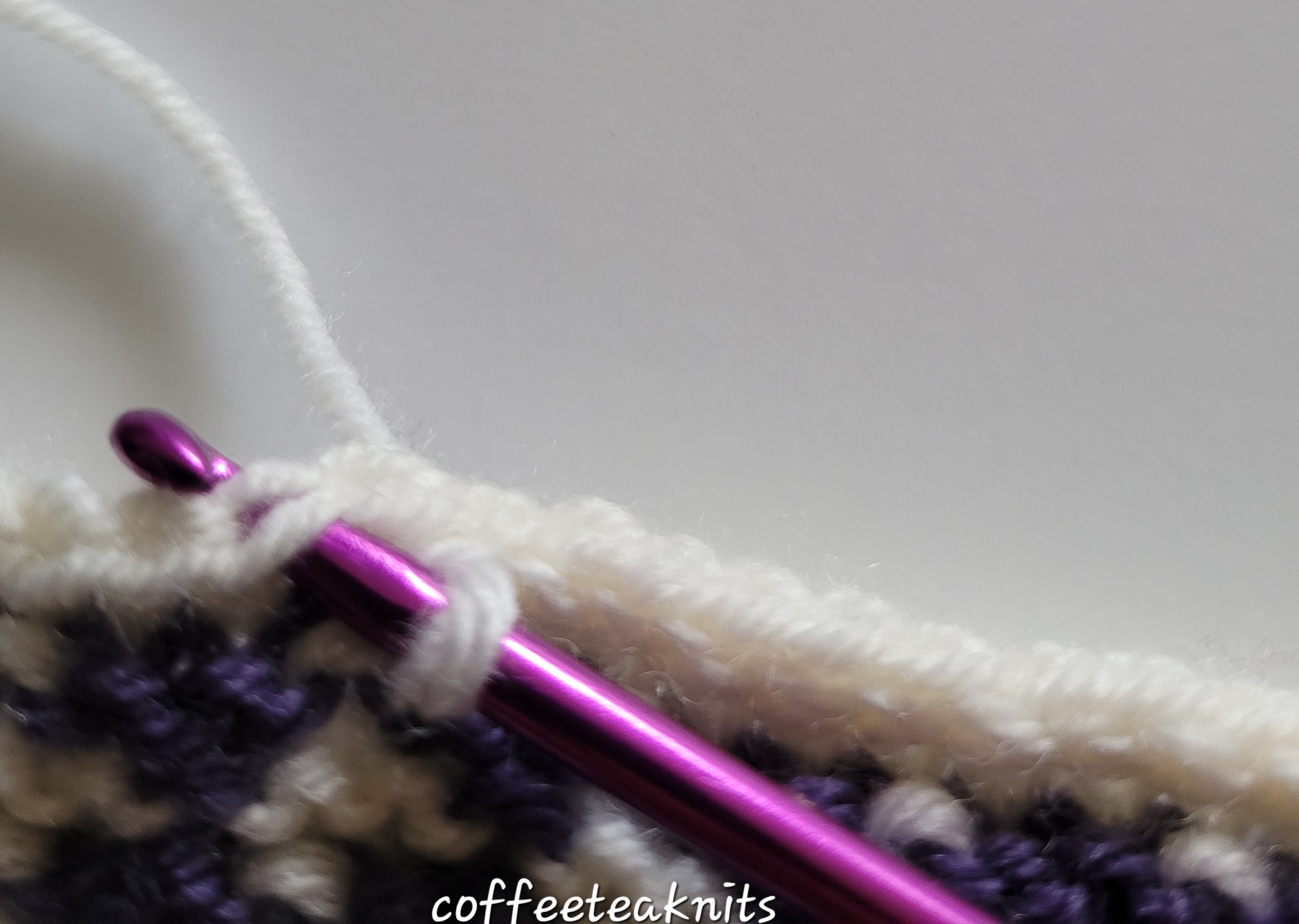
  • With the last stitch on US F-5 hook and Colorway A (cream) yarn, chain 1 and then insert hook under the first bind off stitch, yarn over and pull the yarn over under the bind off stitch and slip stitch it with the first stitch on the hook. Repeat this with the next bid off stitches till one stitch left on the hook. Bring the working yarn through the last stitch.

Feb2023_a

Feb2023_b

Feb2023_c

Feb2023_d

Repeat the same with slip stitch crochet method as above for the cast on stitches with Colorway A yarn and US G-6 hook

Duplicate Stitch or Swiss Darning (optional):
Using a tapestry needle and Colorway A yarn reinforce the first knit stitch of each round with the duplicate stitch (to learn how to do this watch a video tutorial on duplicate stitch by Staci of verypink.com)

Earwamerback_Feb2023

Weave in the ends, wash and block the Interwoven Earwarmer

Feb2023pic


~coffeeteaknits.com