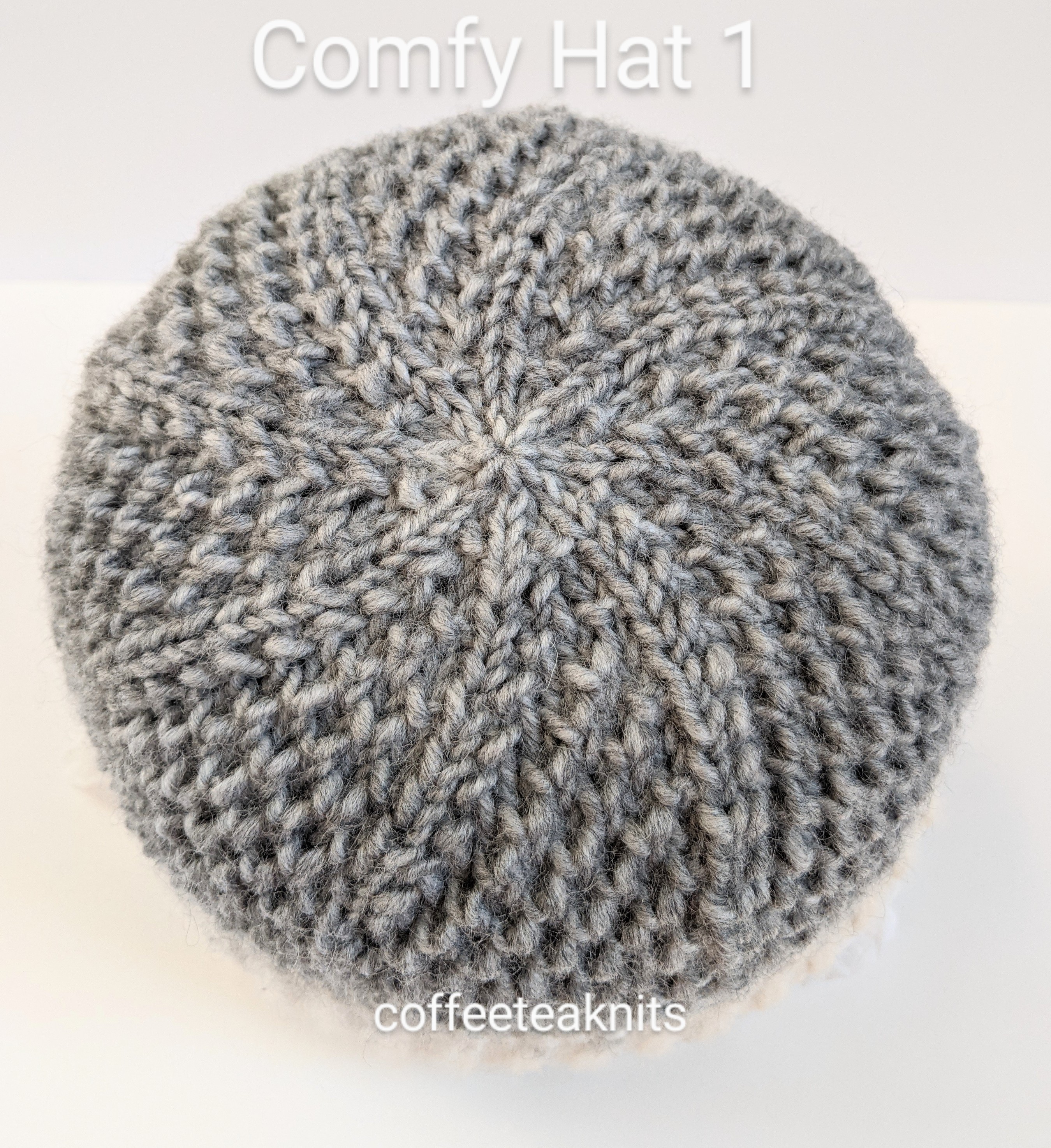
The Comfy Hat Patterns

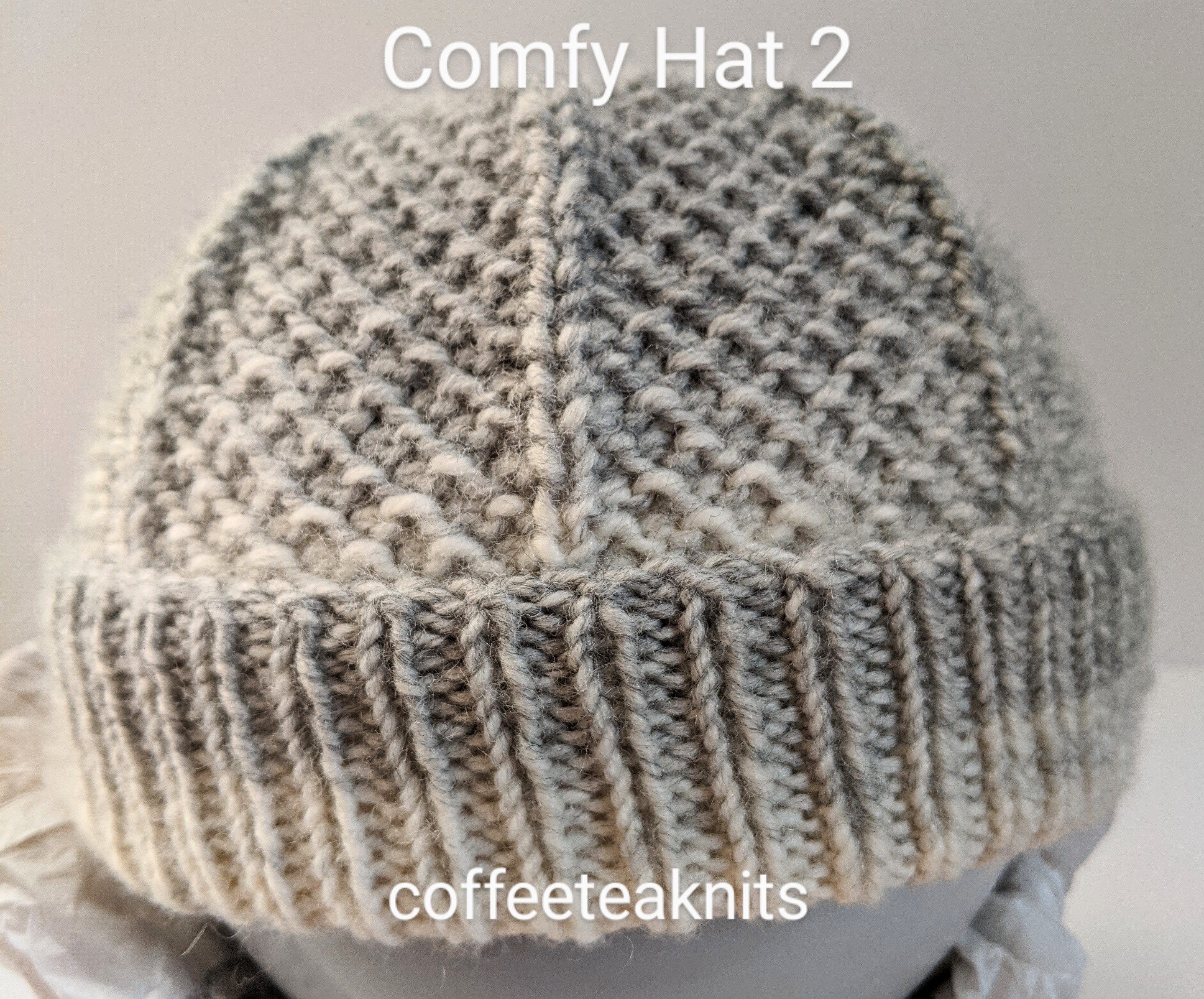
There are some knit stitch patterns that look just as good on the right side as they do on the wrong side. It is so with the twisted seed stitch knit pattern. So I knitted the Comfy Hats with this twisted seed stitch pattern, one with the right side on the outside and the other with the wrong side on the outside. The Lion Brand® Scarfie yarn is warm and comfortable making it the right hat to wear this time of the year. Both hats were knitted bottom up and in the round with a 1 x 1 rib knit stitch pattern folded cuff, a body with the twisted seed stitch pattern, and crown shaping. 

There are two patterns down below for the two hats. The patterns are mostly similar but with a few modifications. These patterns are only for an adult medium hat size. These hats have not been graded for different sizes but the pattern can be easily adapted to different sizes by increasing or decreasing the number of cast on stitches or by increasing or decreasing the number of the pattern repeats.

The Comfy Hat Patterns (text and images for personal use only)

Yarn: Lion Brand® Scarfie Yarn in the Cream/Silver colorway
Knitting Needles: US #7 and US #9 circular knitting needles
Gauge: 17 stitches and 26 rows = 4 inches in stockinette stitch before blocking and with US #7 knitting needles
Abbreviations:

  • K: Knit
  • P: Purl
  • RS: right side
  • WS: wrong side
  • P2tog: Purl two stitches together
  • K2tog: Knit two stitches together
  • K1B: knit below the stitch on the left hand needle 
  • pm: place marker
  • rm: remove marker
  • sm: slip marker
  • BOR marker: beginning of round marker
Comfy Hat Pattern 1Comfy Hat Pattern 2
With US #9 cast on 88 stitches using the cable cast on method, slip stitches on to US #7 circular knitting needles, place a BOR marker and join the round With US #9 cast on 88 stitches using the cable cast on method, slip stitches on to US #7 circular knitting needles, place a BOR marker and join the round
Folded Cuff (1 x 1 rib stitch):
Round 1: [K1, P1] till the BOR marker, slip marker

Repeat Round 1 twenty-four more times (about 4 inches in length)
Folded Cuff (1 x 1 rib stitch):
Round 1: [K1, P1] till the BOR marker, slip marker

Repeat Round 1 twenty-four more times (about 4 inches in length)
Body (Twisted Seed Stitch Pattern):
Setup Round: [purl 10, K1, pm] repeat this 7 more times till the BOR marker, slip the BOR marker

Round 1: [purl till 1 stitch before marker, K1, sm] repeat this 7 more times till the BOR marker, slip the BOR marker

Round 2: [K1, K1B till 1 stitch before marker, K1, sm] repeat this 7 more times till the BOR marker

Round 3: [purl till 1 stitch before marker, K1, sm] repeat this 7 more times till the BOR marker, slip the BOR marker

Round 4: [K1B, K1 till 1 stitch before marker, K1, sm] repeat this 7 more times till the BOR marker


Repeat Rounds 1 – 4 seven more times
Body (Twisted Seed Stitch Pattern):
Setup Round: [purl 11, pm] repeat this 7 more times till the BOR marker, slip the BOR marker

Round 1: [purl to marker, sm] repeat this 7 more times till the BOR marker, slip the BOR marker

Round 2: [K1, K1B till 1 stitch before marker, P1, sm] repeat this 7 more times till the BOR marker

Round 3: [purl to marker, sm] repeat this 7 more times till the BOR marker, slip the BOR marker

Round 4: [K1B, K1 till 1 stitch before marker, P1, sm] repeat this 7 more times till the BOR marker

Repeat Rounds 1 – 4 seven more times


Crown Shaping:
Round 1: [purl till 3 stitches before marker, P2tog, K1, sm] repeat this 7 more times, slip BOR marker

Round 2: [K1, K1B till 2 stitches before marker, K2, sm] repeat this 7 more times, slip BOR marker

Round 3: [purl till 3 stitches before marker, P2tog, K1, sm] repeat this 7 more times, slip BOR marker

Round 4: [K1B, K1 till 1 stitch before marker, K1, sm] repeat this 7 more times, slip BOR marker

Repeat Rounds 1 – 4 three more times


Round 17: [P2tog, K1, sm] repeat this seven more till BOR marker, slip BOR marker

Round 18: Knit all the stitches removing all markers till the BOR marker, slip the BOR marker

Round 19: K2tog till the BOR marker, remove BOR marker, break about 6 inches of the working yarn and thread it through a tapestry needle. Insert the tapestry needle with the working yarn into the remaining stitches, pull tight and secure yarn


Weave in the ends and wash hat.
Crown Shaping:
Round 1: [purl till 3 stitches before marker, P2tog, P1, sm] repeat this 7 more times, slip BOR marker

Round 2: [K1, K1B till 2 stitches before marker, K1, P1, sm] repeat this 7 more times, slip BOR marker

Round 3: [purl till 3 stitches before marker, P2tog, P1, sm] repeat this 7 more times, slip BOR marker

Round 4: [K1B, K1 till 1 stitch before marker, P1, sm] repeat this 7 more times, slip BOR marker

Repeat Rounds 1 – 4 three more times


Round 17: [P2tog, P1, sm] repeat this seven more till BOR marker, slip BOR marker

Round 18: [K1, P1 till marker, rm] repeat till the BOR marker, slip the BOR marker

Round 19: P2tog till the BOR marker, remove BOR marker, break about 6 inches of the working yarn and thread it through a tapestry needle. Insert the tapestry needle with the working yarn into the remaining stitches, pull tight and secure yarn

Turn the hat inside out, weave in the ends and wash hat.


~coffeeteaknits.com

Yarn and a loom

My interest in weaving started more as a way to reduce the amount of yarn I had but now it has grown into a genuine interest in this craft. Weaving dates back to the paleolithic era and is much older than knitting or other fiber related crafts. In 2019 when I got a rigid heddle loom, I found myself learning about warp and weft** and trying out various combinations of plain weaving first with whatever yarn I had on hand and then with yarn bought specifically for weaving. 

Since weaving has been around for so long, there are many different types of weaving patterns other than plain weaving. Other weaving patterns with a rigid heddle loom include soumak, leno, tapestry, and many more. The loom with two heddles and pick up sticks makes double width weaving as well as various twill weave patterns possible. I’ve just begun to discover all these various weaving patterns and combinations.

I find weaving to be much faster than knitting or crocheting. Large projects such as blankets or wraps can be woven in a matter of days rather than months. Weaving has also reduced my yarn stash. Although I still prefer knitting sweaters, hats etc., it is a relief to be able to weave the larger projects quickly. Since I have only one rigid heddle loom I can only weave one project at a time.

Weaving, however, requires more finishing afterwards than knitting or crocheting. For someone who likes seamless knits with minimal finishing, finding the motivation to finish the woven pieces can be quite a task. Also, unlike knitting or crocheting where most of the leftover yarn is left intact, discarding some of the warp yarn still bothers me. Even with these minor drawbacks, I find the craft of weaving very interesting and look forward to learning more about it.


** warp yarn runs lengthwise and is held under tension whereas the weft yarn runs side to side and is inserted by the weaver.


~coffeeteaknits.com

Summertime Dishcloths

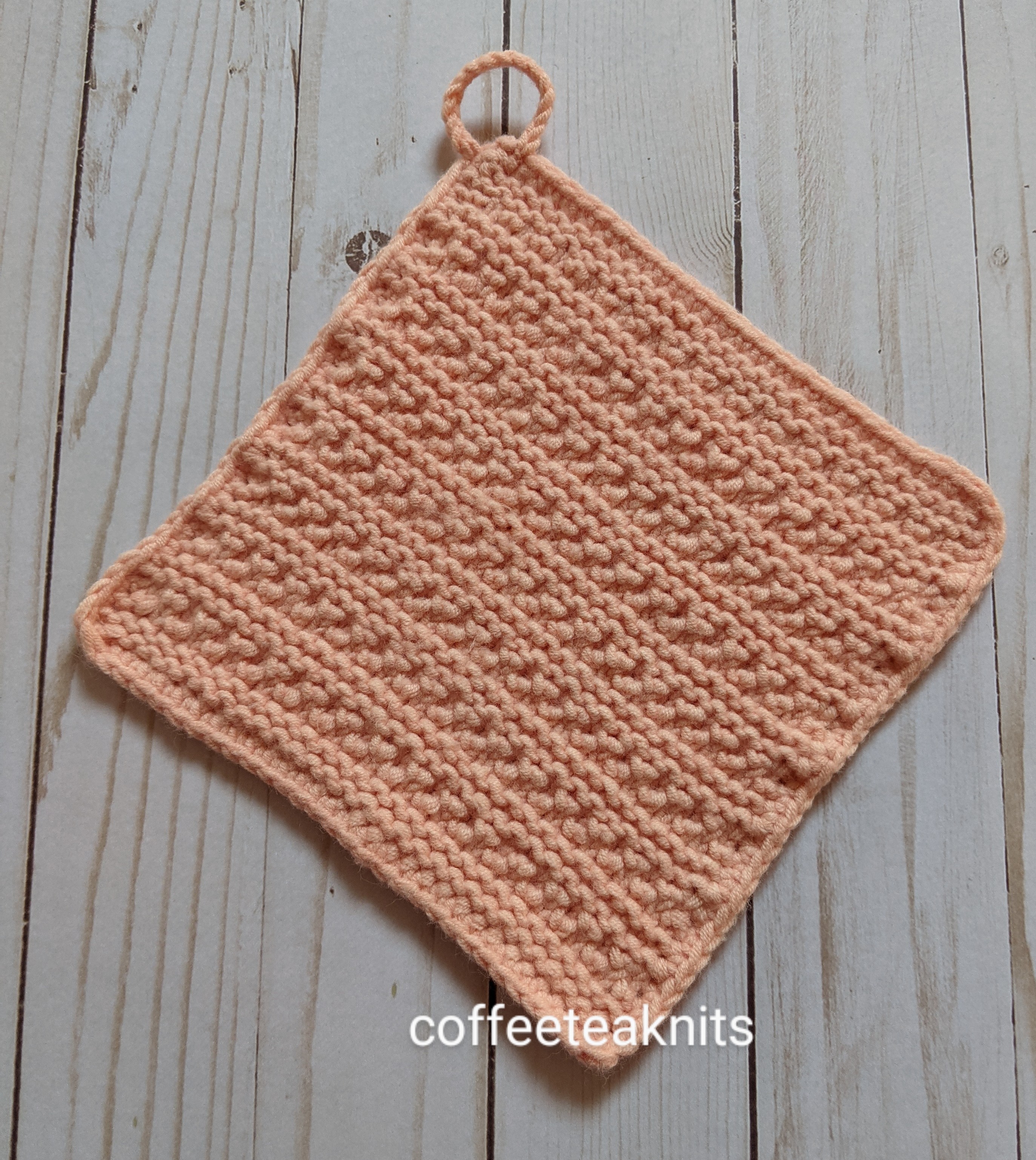
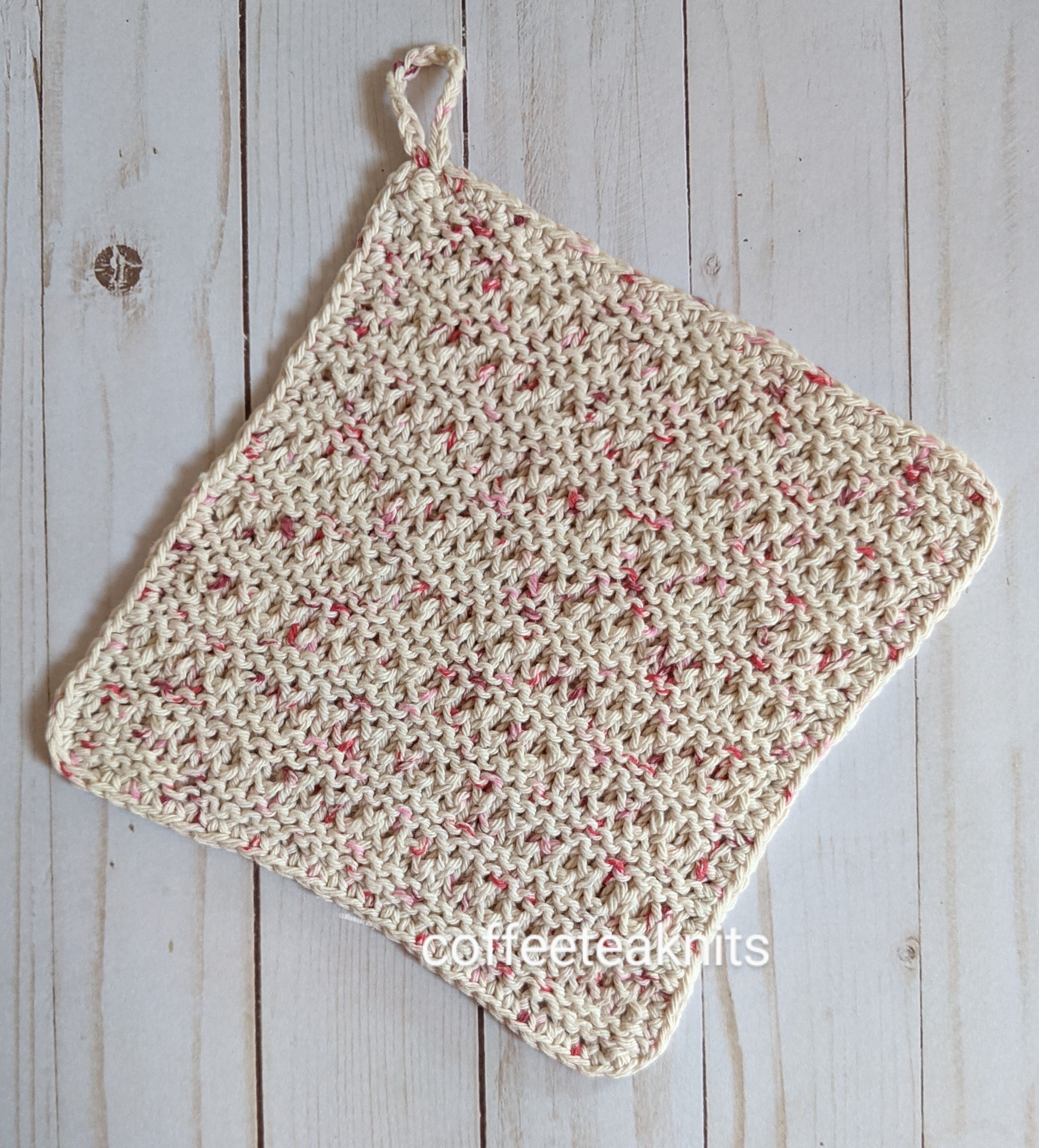
Most summers my sweater knitting with wool or other yarn slows down. I usually weave more or try to knit with cotton yarns during this season. Although this season is more a time for yarn and a loom for me (more details in the next post), I have knitted a few dishcloths including these Summertime Dishcloths. Summertime dishcloths are knit flat from bottom up in a combination of garter stitch and twisted seed stitch pattern.

The Summertime Dishcloths Pattern (text and images for personal use only)

Yarn: Loops & Threads Capri in Apricot colorway for the dishcloth 1
Yarn: Premier Home Cotton in Jelly dots colorway for the dishcloth 2
Knitting Needles: US #8,  and US #10 circular needle for the dishcloth 1
Knitting Needles: US #7,  and US #9 circular needle for the dishcloth 2
Crochet hook: 4.5 mm for the dishcloth 1; 4.0 mm for the dishcloth 2
Gauge: garter stitch pattern – 18 stitches/ 4 inches for the dishcloth 1; 17 stitches/ 4 inches for the dishcloth 2

Abbreviations:

  • K: Knit
  • RS: right side
  • WS: wrong side
  • wyif S1: bring working yarn to the front before slipping the next stitch (in this pattern slip the last stitch)
  • K1B: Knit one stitch below the stitch that is on the left needle
  • [….]: repeat of stitch pattern within a row

Cast on 31 stitches with US #10 needles for the dishcloth 1 or US #9 for the dishcloth 2. Then with US#8 knitting needles for the dishcloth 1 or with US#7 knitting needles for the dishcloth 2 knit as follows: 

  • Row 1 (WS): Knit all stitches to 1 stitch before last, wyif S1
  • Row 2 (RS): Knit all stitches to 1 stitch before last, wyif S1
  • Row 3 (WS): Knit all stitches to 1 stitch before last, wyif S1
  • Row 4 (RS): Knit all stitches to 1 stitch before last, wyif S1
  • Row 5 (WS): Knit all stitches to 1 stitch before last, wyif S1
  • Row 6 (RS): K2, [K1B, K1] till 1 stitch before last, wyif S1
  • Row 7 (WS): Knit all stitches to 1 stitch before last, wyif S1
  • Row 8 (RS): K1, K1B, [K1, K1B] till 1 stitch before last, wyif S1

Repeat Rows 1 to 8, 7 more times ending with Row 8

  • Row (WS): Knit all stitches to 1 stitch before last, wyif S1
  • Row (RS): Knit all stitches to 1 stitch before last, wyif S1
  • Row (WS): Knit all stitches to 1 stitch before last, wyif S1
  • Row (RS): Bind off loosely in knit stitch pattern with a US #10 knitting needle for the dishcloth 1 or US #9 knitting needles for the dishcloth 2 

Insert a 4.5 mm crochet hook for the dishcloth 1 (or 4.0 mm crochet hook for the dishcloth 2) in the last remaining stitch and single crochet all around the dishcloth.

(Optional) – For the hanging loop, chain 15 and slip stitch into the next single crocheted stitch on the crocheted border.
Finish the dishcloths by washing, blocking and weaving in the ends.


~coffeeteaknits.com

The Unexpected Find Wrap

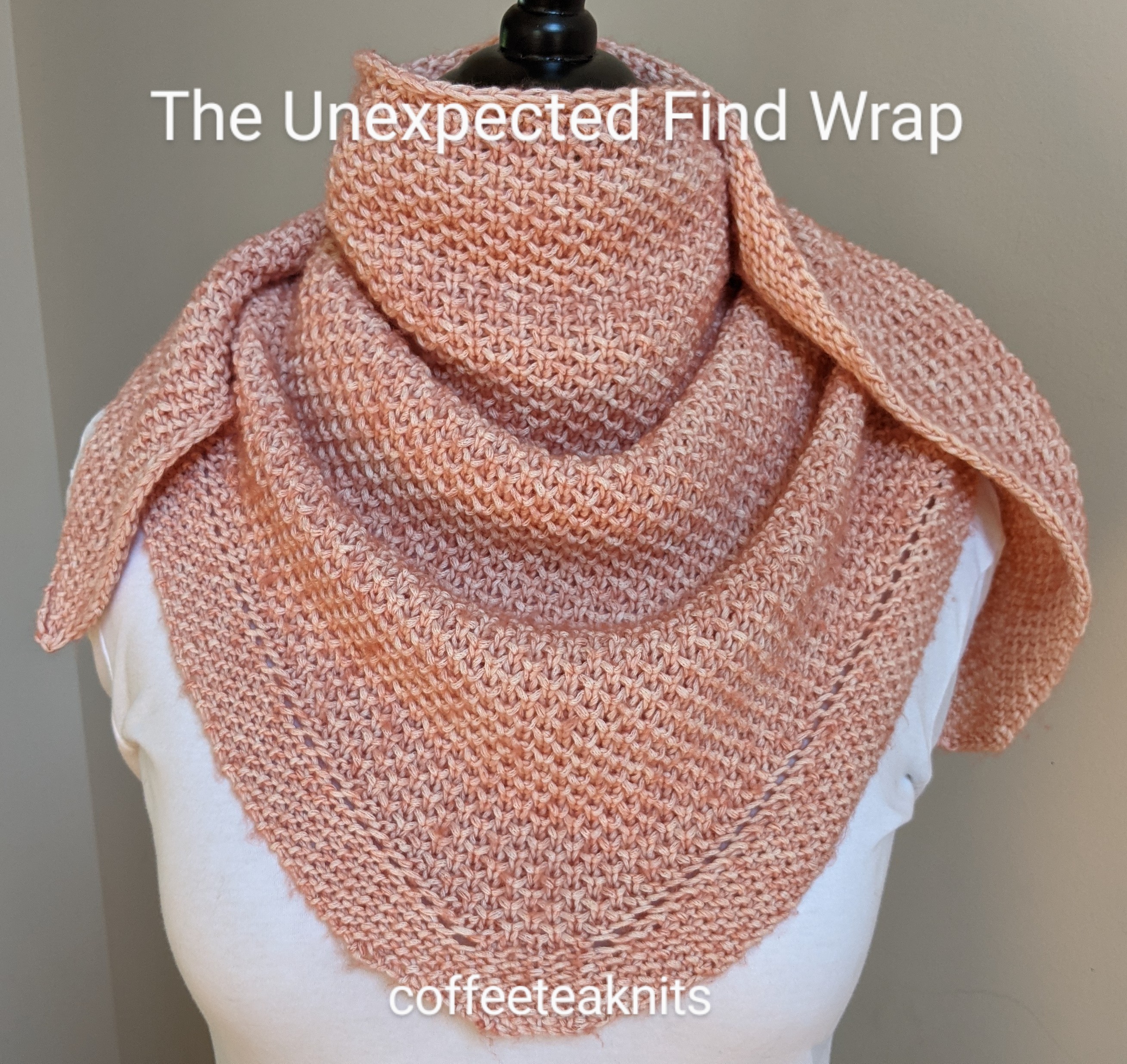
The many different shapes in which shawls or wraps are knitted can be a lesson in geometry. Shawls can be rectangular, squares, circular, triangular or several combinations and variations of these shapes. So, it was inevitable that after knitting several rectangle wraps, square blankets and dishcloths I would dabble in triangular shaped shawl design. Triangular shawls, similar to other shaped shawls, can be knit in several different ways. They can be knit sideways, top down (like the The Sheltering Tree Shawlette), or bottom up like this Unexpected Find Wrap.

The Unexpected Find Wrap pattern is a simple triangular shaped shawl knit bottom up with a two row repeat brioche honeycomb stitch pattern. I happened upon the yarn for this wrap at Joann Fabric and Craft Store. I wasn’t looking for this yarn but once I saw it, I just couldn’t walk away without purchasing it. After casting on a few stitches, the wrap is increased two stitches every other row till the preferred length is reached. This cotton blend wrap is great for those cool summer evenings and also for those overly air conditioned places.

Yarn: K + C  Element Yarn (50 grams each) in Colorway: Pink (Any other worsted weight cotton or cotton blend yarn can be substituted for this yarn)
Knitting Needles: US #8 circular needle
Gauge: 14 stitches/ 4 inches after blocking
Abbreviations:

  • K: Knit
  • P: Purl
  • RS: right side
  • WS: wrong side
  • Kfb: Knit front and back (knit one stitch first in the front and then knit the same stitch in the back before slipping it off the left needle) 
  • K2tog: Knit two stitches together on the left needle 
  • K tbl: knit through the back loop
  • pm: place marker
  • rm: remove marker
  • sm: slip marker
  • S1: slip yarn purlwise
  • yo: yarn over – bring the working yarn under and over the right needle clockwise and to the back before knitting the next stitch
  • yo backward: for bind off only – knit one stitch then wrap the working yarn anticlockwise over and under the right hand knitting needle bringing the yarn to the back before knitting the next stitch
  • BE: abbreviation for the Seed Stitch Border Edge Pattern* (see below)

The Unexpected Find Wrap Pattern (text and image for personal use only)

*Seed Stitch Border Edge Pattern (BE):
Row 1 (RS): K1, P1, K1, P1, K1, P1, K1 (7 stitches)
Row 2 (WS): K1, P1, K1, P1, K1, P1, K1 (7 stitches)

Cast on 7 stitches with US #8 circular knitting needles

  • Row 1 (RS): Kfb, [P1,K1] 2x, P1, Kfb
  • Row 2 (WS): [P1,K1] 4x, P1    
  • Row 3: Kfb, [K1,P1] 3x, K1, Kfb
  • Row 4: [K1,P1] 5x, K1     
  • Row 5: Kfb, [P1,K1] 4x, P1, Kfb
  • Row 6: [P1,K1] 6x, P1 
  • Row 7: Kfb, [K1,P1] 5x, K1, Kfb
  • Row 8: [K1,P1] 7x, K1 
  • Row 9: Kfb, [P1,K1] 6x, P1, Kfb
  • Row 10: [P1,K1] 8x, P1 
  • Row 11: Kfb, [K1,P1] 7x, K1, Kfb
  • Row 12: [K1,P1] 9x, K1 
  • Row 13 (RS): BE, pm, yo, K5, yo, pm, BE
  • Row 14 (WS): BE, sm, K1, K tbl, [yo, S1, K1] 2x, K1, sm, BE
  • Row 15 (RS): BE, sm, yo, K1, [K1, K2tog] 2x, K2, yo, sm, BE 
  • Row 16 (WS): BE, sm, K1, K tbl, [yo, S1, K1] till 1 stitch before marker, K1, sm, BE
  • Row 17 (RS): BE, sm, yo, K1, [K1, K2tog] till 2 stitches before marker, K2, yo, sm, BE

[Repeat Rows 16 and 17] till there is a total of 215 stitches on the needle ending with the RS side row.

Bind Off Row (WS): K1, yo backward, K1, pass the yo and first knit stitch on the right hand needle over the second knit stitch on the right hand needle. (Several video tutorials for other stretchy bind off are available on YouTube). I used Jeny’s Surprisingly Stretchy Bind-Off method in knit stitch pattern for binding off this wrap.

This wrap used about 250 grams of yarn.

Weave in ends, wash and block the wrap.

The Yarn Over Washcloth

The Yarn Over Washcloth

The Yarn Over Washcloth is knit corner to corner with a two row slip stitch pattern. Two stitches are increased every other row and then two stitches are decreased every other row. The washcloth has yarn overs all around between the stitch pattern and the border edge stitches. One stitch is cast on and through a series of increases and decreases this washcloth is worked in one piece ending with a two stitch I-cord hanging loop.

Yarn: Lily Sugar’n Cream in Colorways: Soft Ecru and Butter Cream Ombre
Knitting Needles: US #7 circular needle
Gauge: Not needed for this project
Abbreviations:

  • K: Knit
  • P: Purl
  • RS: right side
  • WS: wrong side
  • Kfb: Knit front and back (knit one stitch first in the front and then knit the same stitch in the back before slipping it off the left needle) – 1 stitch increase 
  • K2tog: Knit two stitches together on the left needle – 1 stitch decrease
  • ssk (left-slanting decrease): slip slip knit (slip 2 stitches to right hand needle then insert the left needle in front of the two slipped stitches and knit them together) – 1 stitch increase
  • rsd (right-slanting decrease): knit 1 stitch, slip one stitch knitwise, return the slipped stitch and the knitted stitch back to the left needle, pass the slipped stitch over the knitted stitch and then return the knitted stitch back to the right needle – 1 stitch decrease
  • sk2p (left-slanting double decrease): slip the next stitch knitwise, k2tog the next two stitches, then pass the slipped stitch over the decreased stitch – 2 stitch decrease
  • rsdd (right-slanting double decrease): slip one stitch knitwise and knit the next stitch. Pass the slipped stitch over the knit stitch. Return this decreased knit stitch back to the left needle and pass the second stitch on the left needle over the decreased stitch. Transfer the decreased stitch back to the right needle – 2 stitch decrease
  • pm: place marker
  • rm: remove marker
  • sm: slip marker
  • wyif S1: with yarn in front slip one stitch purlwise, wrap the working yarn around the front of the slipped stitch and move the yarn to the back
  • yo: yarn over – knit one stitch and then bring the working yarn over the right needle before knitting the next stitch (1 stitch increase)

The Yarn Over Washcloth (text and images for personal use)

Cast on 1 stitch with US #7 circular needle

  • Row 1 (RS): Kfb
  • Row 2 (WS): K2
  • Row 3: Kfb, Kfb
  • Row 4: K4
  • Row 5: Kfb, K2, Kfb
  • Row 6: K6
  • Row 7: Kfb, K4, Kfb
  • Row 8: K8
  • Row 9: Kfb, K6, Kfb
  • Row 10: K4, pm, K2, pm, K4
  • Row 11: K4, sm, yo, K2, yo, sm, K4
  • Row 12: K4, sm, K1, p2, K1, sm, K4
  • Row 13: K4, sm, yo, K1, [K1, wyif S1 then move yarn to the back] to 1 stitch before marker, K1, yo, sm, K4
  • Row 14: K4, sm, K1, purl till 1 stitch before marker, K1, sm, K4

Repeat rows 13 and 14 [repeat section] till 48 stitches on the needle.

Double Decreases:

  • Row 1 (RS): K4, sm, yo, sk2p, [K1, wyif S1 then move yarn to the back] till 3 stitches before marker, rsdd, yo, sm, K4
  • Row 2 (WS): K4, sm, K1, purl till 1 stitch before marker, K1, sm, K4

Repeat these two rows till 14 stitches left on the needle.

  • Row (RS): K4, sm, yo, sk2p, rsdd, yo, sm, K4
  • Row (WS): K4, sm, K1, p2, K1, sm, K4          (12 stitches)

Single decreases:

  • Row 1 (RS):  ssk, knit to 2 stiches before end of the row removing markers, rsd
  • Row 2 (WS): K10

Repeat Rows 1 and 2 till 4 stitches left on the needle.

  • Row (RS): ssk, rsd     (2 stitches left on the needle)

Make an I-cord hanging loop (about 10 to 12 rows) with the 2 stitches on the needle (several tutorials on knitting I-cord are available on YouTube) and bind off.

Attach the I-cord bind off end to the wrong side of the washcloth and weave in ends.

Wash and block the washcloth


Enjoy!


~coffeeteaknits.com