The live stitches on a knitting needle of a knitted piece are secured with a bind off row. This is also the last row. There are many bind off techniques. Some examples include the basic knit bind off, the stretchy bind off and the crochet bind off. Other examples include the picot bind off, the Icelandic bind off and so on. The basic knit method is the most common bind off method. In this technique, the first knitted stitch on the right knitting needle is passed over the second knitted stitch. This basic knit bind off is my favorite for blankets, dishcloths etc. since I can easily pick up the stitches to make a more decorative crochet or knitted border edge. I use knitting needles a size or two larger for the basic knit bind off. This makes the stitches easier to pick up for a border edge. The video and written instructions below for the basic knit bind off method are for right-hand knitting.
The Basic Knit Bind Off:
Written instructions for Basic Knit Bind Off Method:
A knit (Tutorial Series: Knit or Tink) or a purl (Tutorial Series: Purl or Un-Purl) stitch is created through the front loop of the stitch. A variation of the the knit or purl stitch is created through the back loop of the stitch. Knitting or purling through the back loop (K1tbl/Ktbl or P1tbl/Ptbl) twists the stitches. It looks quite different from the knit and purl stitch. K1tbl and P1tbl makes the knitted fabric more dense and is sometimes used in ribbing or as a design element.
The video and written instructions below show how to K1tbl and P1tbl for right-hand knitting.
Knit 1 through the Back Loop (K1tbl):
Written Instructions for Knit 1 through the Back Loop (K1tbl):
Insert the right knitting needle front to back through the back loop of the stitch on the left knitting needle.
Take the working yarn around the top of the right needle and wrap it between the two needles on top of the first stitch
Catch and pick up the working yarn loop (the new stitch) with and onto the right needle
Slip the remaining stitch off the left needle
Purl 1 through the Back Loop (P1tbl):
Written Instructions for Purl 1 through the Back Loop (P1tbl):
Insert the right needle from back to front through the back loop of the stitch on the left knitting needle
Wrap the working yarn around the inserted right needle
Catch the loop made made by the working yarn (the new stitch) with the right needle
Slip the loop (the new stitch) onto the right needle and the old stitch off the left needle
Change is inevitable, whether we want it or not, and embracing it allows us to move forward with enthusiasm. Whenever I face challenges in decision-making, thinking about my favorite activities brings me joy. I like exploring the yarn aisles at arts and craft stores and choosing beautiful yarn. Spending time knitting or crocheting is also a favorite thing of mine. While it’s true that Jo-Ann stores are closing, I will cherish the memories of browsing their colorful yarn selections. I’ve created some wonderful patterns using Jo-Ann yarns, like The Long Striped Crochet Scarf and The Unexpected Find Wrap. I, of course, had to stock up on some Jo-Ann store-brand yarn before the store closes. Every time I knit or crochet with these yarns, I will fondly remember the joy of exploring their yarn aisles.
The Favorite Things Cowls are bandana-style cowls crocheted flat with a variation of the crochet moss stitch pattern. One uses K + C yarn and the other uses Loops and Threads yarn. Both start with a chain of 2 and are increased every other row to form a triangle. The cowl lengths are then extended without any row increases. One cowl is extended over 2 inches long, and the other over 3 inches. The edges of the extended section are joined, and a fringe is added at the end. These cowls are quick one-skein projects, perfect for keeping the neck warm and cozy.
The Favorite Things Cowl Pattern
Materials Needed: Yarn: Cowl 1 – K + C Botanical yarn in Colorway: Feather Gray (one skein of yarn from Jo-Ann store) Yarn: Cowl 2 – Loops and Threads® Luxe Merino™ Wool Blend Colorway: Raindrops Gauge: 4.0 stitches per inch for Favorite Things Cowl 1 and Favorite Things Cowl 2 in the variation crochet moss stitch pattern (gauge not necessary) Crochet hook: US size H-8 (5.00 mm) for Favorite Things Cowl 1 and US size 7 (4.5 mm) for the Favorite Things Cowl 2 Tapestry needle to weave in ends
Abbreviations: sc: single crochet (Tutorial Series: How to Single Crochet) […]: pattern repeat Skill Level: Beginner friendly pattern with single crochet and crochet chains
The Favorite Things Cowl Pattern (images and text for personal use only)
Row 1 (RS): Single crochet, chain 1 in the second foundation chain stitch from the crochet hook, sc, chain 1 again in the same second stitch and turn
Row 2 (WS): Single crochet in the second stitch from the crochet hook, chain 1, skip a stitch and sc in the last stitch, chain 1 and turn (4 stitches)
Row 3 (RS): Single crochet in the second stitch from the crochet hook, chain 1, sc in the same stitch again, chain 1, skip a stitch, and sc in the last stitch, chain 1, sc in the same last stitch again, chain 1 and turn
Row 4 (WS): Single crochet in the second stitch from the crochet hook, chain 1, [skip a stitch, sc in the next stitch, chain 1], repeat […] till the last stitch, sc in the last stitch, chain 1 and turn (8 stitches)
Row 5 (RS): Single crochet in the second stitch from the crochet hook, chain 1, sc in the same stitch again, chain 1, [skip a stitch, sc in the next stitch, chain 1], repeat […] till the last stitch of the row, sc in the last stitch, chain 1, sc again in the same last stitch, chain 1 and turn
Row 6 (WS): Single crochet in the second stitch from the crochet hook, chain 1, [skip a stitch, sc in the next stitch, chain 1], repeat […] till the last stitch, sc in the last stitch, chain 1 and turn (12 stitches)
Repeat Rows 5 and 6 till the cowl is wide enough to fit around the neck with some positive ease. For both cowls I repeated the rows till I reached 92 stitches (Cowl 1 is between 26 – 27 inches and Cowl 2 is between 22 to 23 inches after blocking)
Cowl Length Extended:
Row 1 (RS): Single crochet in the second stitch from the crochet hook, chain 1, [skip a stitch, sc in the next stitch, chain 1], repeat […] till the last stitch, sc in the last stitch, chain 1, and turn
Repeat Row 1 till the preferred length reached. Cowl 1 is a little over 3 inches and Cowl 2 is a little over 2 inches.
Joining the Extended Section: For Cowl 1, I used size H-8 (5.00 mm) crochet hook and the zig zag crochet slip stitch method to join the two edges. For Cowl 2, I just seamed the two edges together with a tapestry needle.
Weave in the ends, wash and block the Favorite Things Cowls
Optional: Add a fringe of preferred length to the foundation chain edge
One variation of single crochet stitch pattern is the single crochet in back loop (SCBL). This stitch pattern is commonly used as a ribbed border for sweaters, blankets etc. In the February 2025 Earwarmer, the ribbing sections for the earwarmers are in the single crochet in the back loop stitch pattern.
Once the foundation row is worked for a single crochet, the crochet hook is inserted only into the back loop for all the the stitches in the next and the subsequent rows. After inserting the crochet hook in the back loop, a single crochet is worked. This differs from a regular single crochet where the crochet hook is inserted under both loops (strands) of a stitch. Using the single crochet in back loops gives the worked fabric a ribbed look.
The video and written instructions are below showing how to make a single crochet in the back loop. This technique is used for all the rows after the foundation chain row. The video and instructions below are for right-handed crocheting
How to Single Crochet in Back Loop (SCBL):
Written Instructions on How to Single Crochet in Back Loop (SCBL):
Hello folks, it’s been a while since my last pattern post. A bad case of the flu at the end of January, the passing of my adorable pet dog in mid-February, and other personal issues needed my time. I started working on the February 2025 Earwarmer crochet pattern a few days before my beloved dog passed away. I am grateful that my knitting and crocheting hobby gave me much-needed comfort. It supported me during this difficult period of grief and reflection. I am also thankful to all the readers and subscribers of this blog. I appreciate the knitting and crocheting community for their support and understanding.
The February 2025 Earwarmer is crocheted flat and then the two ends are joined together with slip stitch crochet. The construction of this Earwarmer pattern is comparable to the “Goes with Everything Earwarmer” knitted version. It starts with a chain of eight stitches and ribbing. Then, it goes through a series of increases and length extension. It ends with a series of decreases and ribbing. The two ends are then joined together with a slip stitch crochet. A variation of the crochet moss stitch pattern is used for both earwarmers. February 2025 Earwarmer 1 is made with a cotton blend yarn and measures about 4.5 inches x 20 inches. February 2025 Earwarmer 2 is made with a merino wool blend yarn and measures about 4 inches x 19 inches.
The February 2025 Earwarmer Pattern
Materials Needed: Yarn: Earwarmer 1 – Caron Blossom Cakes® yarn in Colorway: Bark Yarn: Earwarmer 2 – Loops and Threads® Luxe Merino™ Wool Blend Colorway: Raindrops Gauge: 5.5 stitches per inch for Earwarmer 1 and 5.0 stitches per inch for Earwarmer 2 in the variation crochet moss stitch pattern Crochet hook: US size H-8 (5.00 mm) for February 2025 Earwarmer 1 and US size 7 (4.5 mm) for the February 2025 Earwarmer 2 Tapestry needle to weave in ends
Abbreviations: sc: single crochet (Tutorial Series: How to Single Crochet) scbl: single crochet in the back loop (insert crochet hook in the back strand of the stitch only) […]: pattern repeat Skill Level: Beginner friendly pattern with single crochet, single crochet in the back loop, and crochet slip stitch)
The February 2025 Earwarmer Pattern (text and images for personal use only)
The February 2025 Earwarmer pattern is made up of the following sections:
Foundation Chain
Ribbing
Increase
Length Extension
Decrease
Ribbing
Joining of the foundation row and the last (bind off) rows
Foundation Chain:
For February 2025 Earwarmer 1: Chain 8 stitches using crochet hook size H-8 (5.00 mm) For February 2025 Earwarmer 2: Chain 8 stitches using crochet hook size 7 (4.50 mm)
Foundation Chain Set up and Ribbing Section:
Row 1 (RS): Skip the first stitch, [single crochet the purl bump in the back the next stitch], repeat […] till the last stitch, sc the purl bump in the back of the last stitch (on the slip knot side), chain 1 and turn
Row 2 (WS): Skip the first stitch, sc under both strands of the next stitch, [scbl (single crochet in the back loop) in the next stitch], repeat […] till the last stitch, sc under both strands of the the last stitch, chain 1 and turn
Row 3 (RS): Repeat Row 2
Row 4 (WS): Repeat Row 2
Row 5: Repeat Row 2
Row 6: Repeat Row 2
Row 7: Repeat Row 2
Row 8: Repeat Row 2
Increase Section:
Row 9 (RS): Skip the first stitch and sc in the next stitch, chain 1 and sc again in the same stitch, chain 1, [skip a stitch, sc in the next next stitch, chain1], repeat […] till 2 stitches left, sc in the last stitch, chain 1, sc again in the same stitch, chain 1 and turn
Row 10 (WS): [Skip the first stitch, sc in the next stitch, chain 1], repeat […] till the last stitch, sc in the last stitch, chain 1 and turn – 12 stitches
Row 11 (RS): Repeat Row 9
Row 12 (WS): Repeat Row 10 – 16 stitches
Row 13 (RS): Repeat Row 9
Row 14 (WS): Repeat Row 10 – 20 stitches
Row 15 (RS): Repeat Row 9
Row 16 (WS): Repeat Row 10 – 24 stitches
Customization Option: Repeat Rows 9 and 10 to increase the number of stitches to preferred size
Length Extension Section:
Row 17 (RS): [Skip the first stitch and sc in the next stitch, chain 1], repeat […] till 2 stitches left, sc in the last stitch, chain 1, and turn
Row 18 (WS): Repeat Row 17
Repeat Rows 17 and 18 till preferred length reached. The length extension for Earwarmer 1 is about 12 inches and for Earwarmer 2 it’s almost 11.5 inches
Decrease Section:
Decrease Section Row 1 (RS): Skip the first stitch, insert crochet hook into the next stitch, yarn over and pull the loop under and through that stitch (there are 2 loops on the crochet hook), skip a stitch and insert hook in the next stitch (4th stitch from the beginning), yarn over and pull the loop under and through that stitch (three loops on the hook now), yarn over and pull loop through the three loops on the hook, chain 1, [skip a stitch, sc in the next stitch, chain 1], repeat […] till 4 stitches left, insert crochet hook into the next stitch, yarn over and pull the loop under and through that stitch (there are 2 loops on the crochet hook), skip a stitch and insert hook in the last stitch, yarn over and pull the loop under and through that stitch (three loops on the hook), yarn over and pull loop through the three loops on the hook, chain 1 and turn
Decrease Section Row 2 (WS): [Skip the first stitch and sc in the next stitch, chain 1], repeat […] till 2 stitches left, sc in the last stitch, chain 1, and turn – 20 stitches left
Customization Option: Repeat Decrease Section Rows 1 and 2 if there are more than 24 stitches
Ribbing Section:
Decrease Section Row 9 (RS): Skip the first stitch, sc under both strands of the next stitch, [scbl (single crochet in the back loop) in the next stitch], repeat […] till the last stitch, sc under both strands of the the last stitch, chain 1 and turn
Crochet Slip Stitch Join of the Last (Bind-off) and the Foundation Rows:
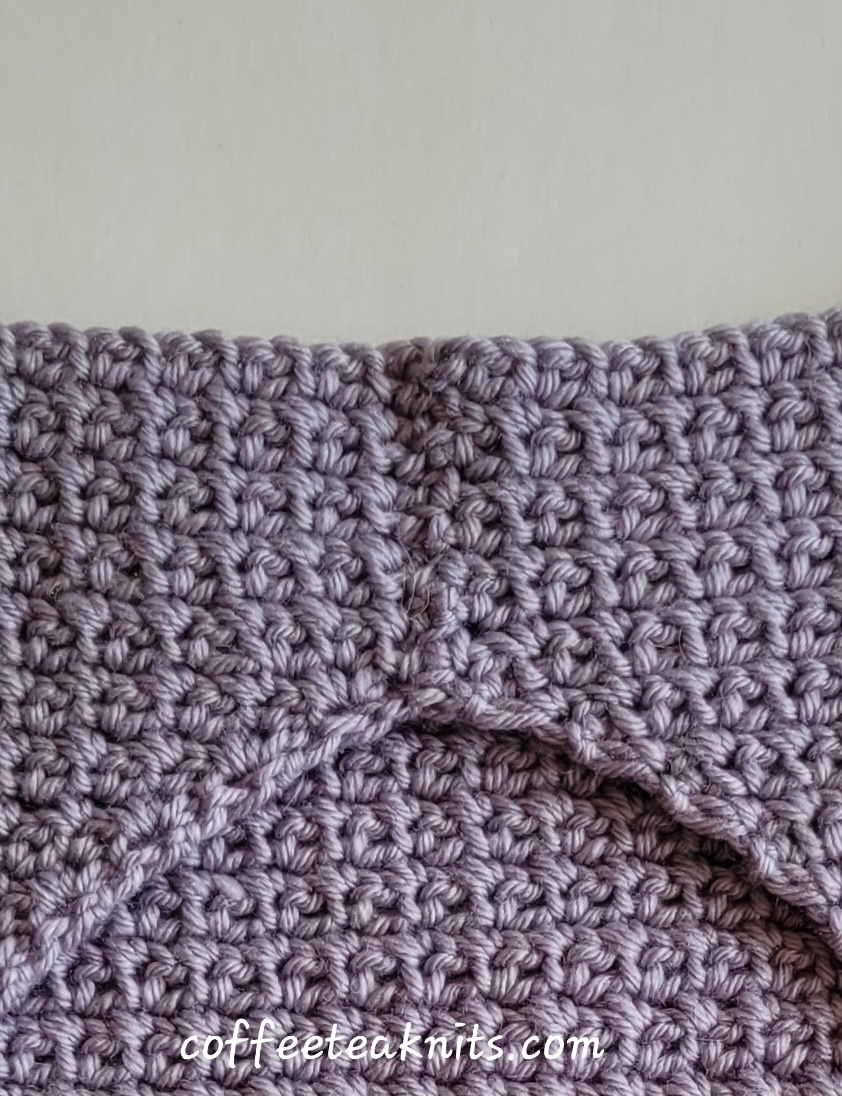
The earwarmer pattern is reversible so either sides can be used for joining. As in the image above, insert the crochet hook into the first stitch of the foundation row first, then insert it into the last stitch of the last (bind off) row, yarn over and pull the loop through both stitches for a slip stitch join, repeat to the last stitches of both ends and pull yarn through (see video below)
The joined foundation and last row of the earwarmers:
Weave in the ends, wash and block the February 2025 Earwarmers
Comment below if you also find knitting and crocheting therapeutic?