When life gave me yarn revisited

It’s been five years since the March 2020 post “When life gave me yarn“. At that time a stay at home order was in place for a couple of weeks due to the coronavirus.

What yarn meant to me then:

March 2020

When life gave me yarn, I became an avid knitter.
I started a knitting blog and embarked on a journey paved with intricate designs, colors, and textures.
Thoughts of becoming a fiber artist crossed my path several times.
On this path I also picked up the yarn related crafts of crocheting and weaving.
All throughout the journey recurring dreams of someday designing my own yarn related items beckoned me towards more and more yarn.
Now, despite my efforts to the contrary, the yarn in my life keeps growing and growing.
So, tell me my friends, is this yarn in my life just a temporary haven or is the yarn calling me?

coffeeteaknits.com


And what yarn is to me now:

July 2025

When life gave me yarn, I became an avid knitter and crocheter.
On this journey paved with intricate designs and texture, I discovered the strength of prayer and manifestation.
The meditative rhythm of fiber related crafts soothed me during coronovirus pandemic and health issues.
While on this path I became immersed in creating video tutorials.
Recurring dreams of someday designing my own yarn related items led to publishing fifty two patterns and more yarn.
Now, I’m grateful for the abundance of yarn in my life.
So, tell me my friends, is this yarn in my life here to stay? If so, I must answer.

coffeeteaknits.com

The image in the background above is a cloth I wove using the rigid heddle loom. The yarn Home Cotton® Cone Select Colors in Vineyard Dots colorway for the warp and Jelly Dots colorway for the weft.


Thank you to the fiber related crafts community, subscribers and readers of this blog for your feedback and encouragement all along my journey with yarn.


~coffeeteaknits.com

Tutorial Series: The Basic Knit Bind Off

The live stitches on a knitting needle of a knitted piece are secured with a bind off row. This is also the last row. There are many bind off techniques. Some examples include the basic knit bind off, the stretchy bind off and the crochet bind off. Other examples include the picot bind off, the Icelandic bind off and so on. The basic knit method is the most common bind off method. In this technique, the first knitted stitch on the right knitting needle is passed over the second knitted stitch. This basic knit bind off is my favorite for blankets, dishcloths etc. since I can easily pick up the stitches to make a more decorative crochet or knitted border edge. I use knitting needles a size or two larger for the basic knit bind off. This makes the stitches easier to pick up for a border edge. The video and written instructions below for the basic knit bind off method are for right-hand knitting.

The Basic Knit Bind Off:


Written instructions for Basic Knit Bind Off Method:

  1. Knit (Tutorial Series: Knit and Tink) the first 2 stitches at beginning of the row
  2. Pass the first stitch knitted over the second stitch on the right hand knitting needle
  3. Slip the passed stitch off the right knitting needle (one stitch remains on the needle)
  4. Knit the next stitch on the left knitting needle
  5. Pass and slip the remaining stitch over the newly knitted stitch on the right knitting needle (one stitch remains on the right knitting needle)
  6. Repeat Steps 5 and 6 till the end of the row
  7. Break yarn and pull the working yarn through the last remaining stitch

~coffeeteaknits.com

Tutorial Series: K1tbl and P1tbl

A knit (Tutorial Series: Knit or Tink) or a purl (Tutorial Series: Purl or Un-Purl) stitch is created through the front loop of the stitch. A variation of the the knit or purl stitch is created through the back loop of the stitch. Knitting or purling through the back loop (K1tbl/Ktbl or P1tbl/Ptbl) twists the stitches. It looks quite different from the knit and purl stitch. K1tbl and P1tbl makes the knitted fabric more dense and is sometimes used in ribbing or as a design element.


The video and written instructions below show how to K1tbl and P1tbl for right-hand knitting.

Knit 1 through the Back Loop (K1tbl):


Written Instructions for Knit 1 through the Back Loop (K1tbl):

  • Insert the right knitting needle front to back through the back loop of the stitch on the left knitting needle.
  • Take the working yarn around the top of the right needle and wrap it between the two needles on top of the first stitch
  • Catch and pick up the working yarn loop (the new stitch) with and onto the right needle
  • Slip the remaining stitch off the left needle

Purl 1 through the Back Loop (P1tbl):


Written Instructions for Purl 1 through the Back Loop (P1tbl):

  • Insert the right needle from back to front through the back loop of the stitch on the left knitting needle
  • Wrap the working yarn around the inserted right needle
  • Catch the loop made made by the working yarn (the new stitch) with the right needle
  • Slip the loop (the new stitch) onto the right needle and the old stitch off the left needle

~coffeeteaknits.com

The Springtime Baby Blanket Pattern


Early in my knitting and crocheting journey, I bought several one-skein yarns for blankets. These yarns weigh about 454 grams and are perfect for making a baby blanket (Lion Brand yarn). I’ve made several blankets over the years, but I still have some one-skein yarn left. Starting now, I want to use up all my one-skein yarn and any leftover yarn from past projects this year. I intend to work on knitting/crochet patterns that are quick and simple to use up most of these one-skein yarns.

Center-out and in the round technique is one way to use up most of these one-skein yarn. Another way is the corner to corner technique. The Springtime Baby Blanket is crocheted flat from corner to corner using a single crochet, chain one stitch pattern. The Springtime Baby Blanket starts with a chain of 2. Then, four stitches are increased every other row. This continues until the midpoint is reached. It is then decreased by four stitches every other row down to 2 stitches. The blanket is finished with a border in the crochet moss stitch pattern. The Springtime Baby Blanket pattern is beginner friendly and can be customized easily. Weigh any amount of one-skein yarn and set aside equal amounts for the increase and decrease sections. Also, reserve some extra amount for the border.

The Springtime Baby Blanket Pattern (text and images for personal use only)

Materials Needed:
Yarn: Lion Brand Pound of Love® Yarn in Pastel Yellow colorway (454 grams). Although the pastel yellow colorway is not available now, similar shade can be found in stores today
Gauge:  4.5 stitches per inch in the variation crochet moss stitch pattern 
Crochet hook: US size H-8 (5.00 mm) 
Tapestry needle to weave in ends

Abbreviations:
sc: single crochet (Tutorial Series: How to Single Crochet)
[…]: pattern repeat
Skill Level: Beginner friendly pattern with single crochet and crochet chains

Crochet Foundation Chain:

  • Chain 2 using US size H-8 (5.00 mm) crochet hook

Increase Section:

  • Row 1 (RS): Single crochet, chain 1 in the second foundation chain stitch from the crochet hook, sc, chain 1 again in the same second stitch and turn
  • Row 2 (WS): Single crochet in the second stitch from the crochet hook, chain 1, skip a stitch and sc in the last stitch, chain 1 and turn (4 stitches)
  • Row 3 (RS): Single crochet in the second stitch from the crochet hook, chain 1, sc in the same stitch again, chain 1, skip a stitch, and sc in the last stitch, chain 1, sc in the same last stitch again, chain 1 and turn 
  • Row 4 (WS): Single crochet in the second stitch from the crochet hook, chain 1, [skip a stitch, sc in the next stitch, chain 1], repeat […] till the last stitch, sc in the last stitch, chain 1 and turn (8 stitches)
  • Row 5 (RS): Single crochet in the second stitch from the crochet hook, chain 1, sc in the same stitch again, chain 1, [skip a stitch, sc in the next stitch, chain 1], repeat […] till the last stitch of the row, sc in the last stitch, chain 1, sc again in the same last stitch, chain 1 and turn 
  • Row 6 (WS): Single crochet in the second stitch from the crochet hook, chain 1, [skip a stitch, sc in the next stitch, chain 1], repeat […] till the last stitch, sc in the last stitch, chain 1 and turn (12 stitches)

Repeat Rows 5 and 6 till 204 stitches in the row (about 200 grams of yarn). I put aside about 50 grams for the border.

Decrease Section:

  • Row 1 (RS): Skip the first stitch, insert crochet hook into the next stitch, wrap yarn around the crochet hook and pull the loop under and through that stitch (there are 2 loops on the crochet hook), skip a stitch and insert hook in the next stitch (4th stitch from the beginning), wrap yarn around the crochet hook and pull the loop under and through that stitch (three loops on the hook now), yarn over and pull loop through the three loops on the hook, chain 1, [skip a stitch, sc in the next stitch, chain 1], repeat […] till 4 stitches left, insert crochet hook into the next stitch, yarn over and pull the loop under and through that stitch (there are 2 loops on the crochet hook), skip a stitch and insert hook in the last stitch, yarn over and pull the loop under and through that stitch (three loops on the hook), yarn over and pull loop through the three loops on the hook, chain 1 and turn
  • Row 2 (WS): [Skip the first stitch and sc in the next stitch, chain 1], repeat […] till 2 stitches left, sc in the last stitch, chain 1, and turn 

Repeat Rows 1 and 2 till 4 stitches left in the row. Facing the right side of the work, wrap yarn around the crochet hook and pull the loop under and through that stitch (there are two loops on the crochet hook), skip a stitch and insert hook in the last stitch (three loops on the hook now), yarn over and pull loop through the three loops on the hook (one loop remaining on the hook)

Crochet Moss Stitch Border (in the round):

Round 1:

  • With the remaining loop on the hook, chain 2, sc in the same stitch again and chain 2 (beginning of round). Facing the top left corner of right side of the blanket turn counter clockwise
  • Pick up stitches in the crochet in moss stitch pattern (pick up a stitch and sc, chain 2, skip the next stitch and repeat) all along the left side
  • At the bottom left corner edge stitch of the right side of the blanket, sc, chain 2, sc again in the same corner stitch, chain 2
  • Turn and pick up stitches in the crochet moss stitch pattern (pick up a stitch and sc, chain 2, skip the next stitch and repeat) along the bottom edge.
  • At the bottom right corner edge stitch of the right side of the blanket, sc, chain 2, sc again in the same corner stitch, chain 2
  • Turn and pick up stitches in the crochet in moss stitch pattern (pick up a stitch and sc, chain 2, skip the next stitch and repeat) going up all along the right side
  • At the top right corner edge stitch of the right side of the blanket, sc, chain 2, sc again in the same corner stitch, chain 2
  • Turn and pick up stitches in the last row in the crochet in moss stitch pattern (pick up a stitch and sc, chain 2, skip the next stitch and repeat) along that last row

Rounds 2 to 5:

  • At the corner edge stitch (beginning of the round), sc , chain 2, sc again in the same corner stitch, chain 2
    Crochet moss stitch (sc in the chain 2 space, chain 2, skip the next stich and repeat) all around the blanket with a sc, chain 2, sc, chain 2 at each of the corner edge stitches

Single crochet in the first beginning of round stitch, cut yarn and pull yarn through the loop

Weave in ends, wash and block the Springtime Baby Blanket


~coffeeteaknits.com

Tutorial Series: Single Crochet in Front Loop (SCFL)

Another variation of single crochet is the single crochet in front loop (SCFL). The stitch pattern gives a changed texture to a garment. This stitch pattern looks quite different from SCBL (Tutorial Series: Single Crochet in Back Loop).  


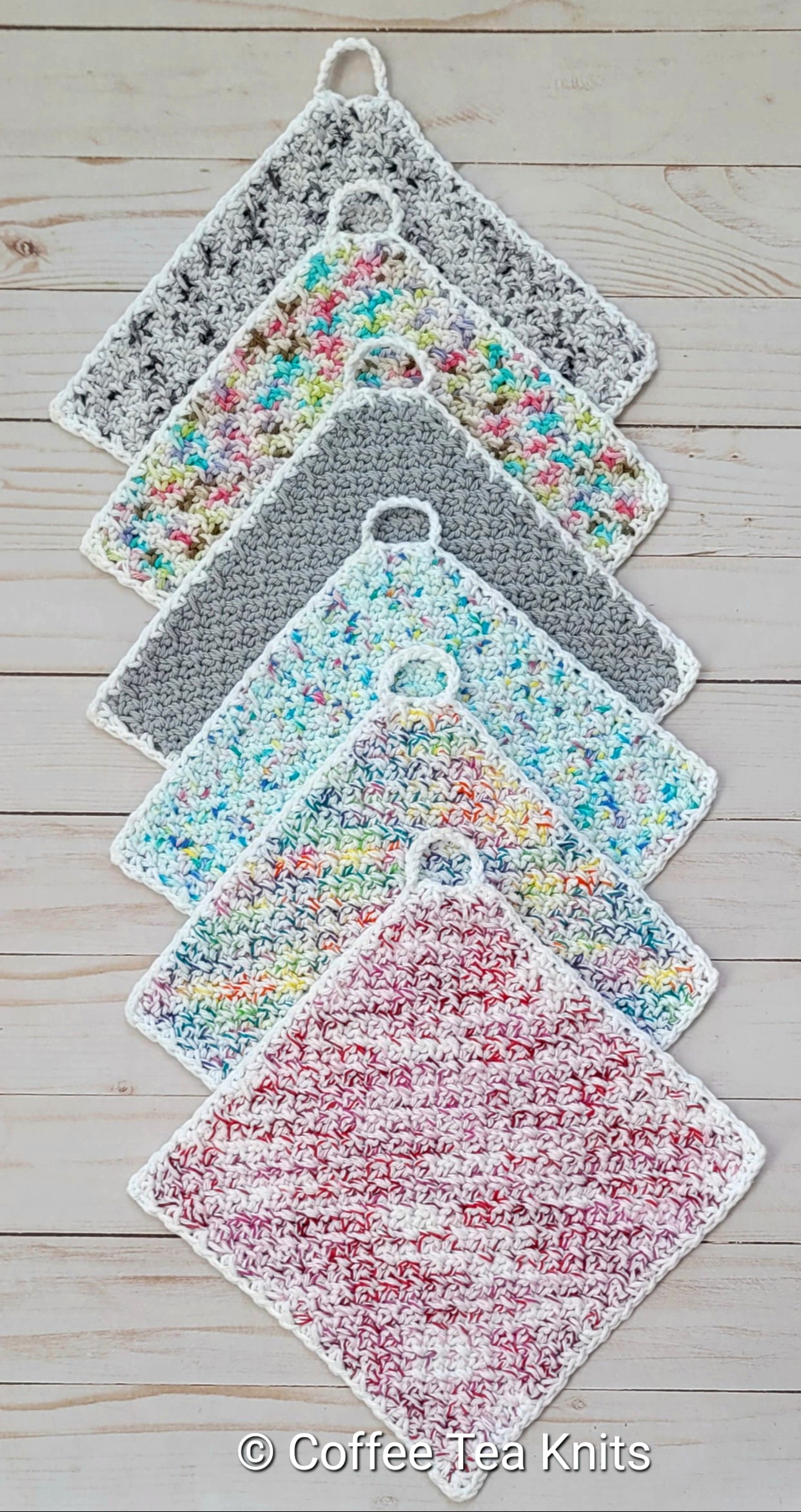
The Suddenly It’s Summer Dishcloth Pattern is in single crochet in the front loop (SCFL). This stitch pattern can also be used for blankets, garments etc.

Suddenly It’s Summer Dishcloth

After the foundation row for a single crochet has been worked (Tutorial Series: How to Single Crochet), all the following rows are worked only into the front loop. This gives the fabric a distinct textured pattern on both sides of the work. The video and written instructions provided below show how to make a single crochet in the front loop holding the crochet hook in your right hand.

How to Single Crochet in Front Loop (SCFL):


Written Instructions on How to Single Crochet in Front Loop (SCFL):

  1. After working single crochet in the last stitch of the foundation chain row (Tutorial Series: How to Single Crochet), chain one and turn
  2. Skip the first stitch from the hook, and insert crochet hook in the front loop of the next stitch
  3. Catch and pull yarn loop under and through the front loop of the stitch
  4. There are two loops on the crochet hook now
  5. Yarn over (wrap the working yarn around the hook counterclockwise)
  6. Catch and pull yarn through the remaining two loops on the hook.
  7. There is one loop left on the crochet hook
  8. Repeat Steps 2 to 7 till end of the row and all other subsequent rows (chain one after working the last stitch end of each row and turn to the next row)

~coffeeteaknits.com

Tutorial Series: How to Single Crochet in Back Loop (SCBL)

One variation of single crochet stitch pattern is the single crochet in back loop (SCBL). This stitch pattern is commonly used as a ribbed border for sweaters, blankets etc. In the February 2025 Earwarmer, the ribbing sections for the earwarmers are in the single crochet in the back loop stitch pattern.


Once the foundation row is worked for a single crochet, the crochet hook is inserted only into the back loop for all the the stitches in the next and the subsequent rows. After inserting the crochet hook in the back loop, a single crochet is worked. This differs from a regular single crochet where the crochet hook is inserted under both loops (strands) of a stitch. Using the single crochet in back loops gives the worked fabric a ribbed look.


The video and written instructions are below showing how to make a single crochet in the back loop. This technique is used for all the rows after the foundation chain row. The video and instructions below are for right-handed crocheting

How to Single Crochet in Back Loop (SCBL):


Written Instructions on How to Single Crochet in Back Loop (SCBL):

  1. After working single crochet (Tutorial Series: How to Single Crochet) in the last stitch of the foundation chain row, chain one and turn
  2. Skip the first stitch and insert crochet hook in the back loop of the next stitch
  3. Catch and pull yarn loop under the back loop of the stitch and on to the crochet hook
  4. There are two loops on the crochet hook now
  5. Yarn over (wrap the working yarn around the hook counterclockwise)
  6. Catch and pull yarn through the remaining two loops on the hook.
  7. There is one loop left on the crochet hook.
  8. Insert hook into the back loop of the next stitch and repeat Steps 3 to 7 till the end of the row
  9. Chain one after working the last stitch of the row and turn to the next row
  10. Repeat Steps 8 and 9 for all subsequent rows as specified in a pattern.

~coffeeteaknits.com

The February 2025 Earwarmer Pattern


Hello folks, it’s been a while since my last pattern post. A bad case of the flu at the end of January, the passing of my adorable pet dog in mid-February, and other personal issues needed my time. I started working on the February 2025 Earwarmer crochet pattern a few days before my beloved dog passed away. I am grateful that my knitting and crocheting hobby gave me much-needed comfort. It supported me during this difficult period of grief and reflection. I am also thankful to all the readers and subscribers of this blog. I appreciate the knitting and crocheting community for their support and understanding.

The February 2025 Earwarmer is crocheted flat and then the two ends are joined together with slip stitch crochet. The construction of this Earwarmer pattern is comparable to the “Goes with Everything Earwarmer” knitted version. It starts with a chain of eight stitches and ribbing. Then, it goes through a series of increases and length extension. It ends with a series of decreases and ribbing. The two ends are then joined together with a slip stitch crochet. A variation of the crochet moss stitch pattern is used for both earwarmers. February 2025 Earwarmer 1 is made with a cotton blend yarn and measures about 4.5 inches x 20 inches. February 2025 Earwarmer 2 is made with a merino wool blend yarn and measures about 4 inches x 19 inches.

The February 2025 Earwarmer Pattern

Materials Needed:
Yarn: Earwarmer 1 – Caron Blossom Cakes® yarn in Colorway: Bark
Yarn: Earwarmer 2 – Loops and Threads® Luxe Merino™ Wool Blend Colorway: Raindrops
Gauge: 5.5 stitches per inch for Earwarmer 1 and 5.0 stitches per inch for Earwarmer 2 in the variation crochet moss stitch pattern
Crochet hook: US size H-8 (5.00 mm) for February 2025 Earwarmer 1 and US size 7 (4.5 mm) for the February 2025 Earwarmer 2
Tapestry needle to weave in ends

Abbreviations:
sc: single crochet (Tutorial Series: How to Single Crochet)
scbl: single crochet in the back loop (insert crochet hook in the back strand of the stitch only)
[…]: pattern repeat
Skill Level: Beginner friendly pattern with single crochet, single crochet in the back loop, and crochet slip stitch)

The February 2025 Earwarmer Pattern (text and images for personal use only)

The February 2025 Earwarmer pattern is made up of the following sections:

      • Foundation Chain 
      • Ribbing
      • Increase
      • Length Extension
      • Decrease
      • Ribbing
      • Joining of the foundation row and the last (bind off) rows

Foundation Chain:

For February 2025 Earwarmer 1: Chain 8 stitches using crochet hook size H-8 (5.00 mm)
For February 2025 Earwarmer 2: Chain 8 stitches using crochet hook size 7 (4.50 mm)


Foundation Chain Set up and Ribbing Section:

  • Row 1 (RS): Skip the first stitch, [single crochet the purl bump in the back the next stitch], repeat […] till the last stitch, sc the purl bump in the back of the last stitch (on the slip knot side), chain 1 and turn

  • Row 2 (WS): Skip the first stitch, sc under both strands of the next stitch, [scbl (single crochet in the back loop) in the next stitch], repeat […] till the last stitch, sc under both strands of the the last stitch, chain 1 and turn 
  • Row 3 (RS): Repeat Row 2
  • Row 4 (WS): Repeat Row 2
  • Row 5: Repeat Row 2
  • Row 6: Repeat Row 2
  • Row 7: Repeat Row 2
  • Row 8: Repeat Row 2

Increase Section:

  • Row 9 (RS): Skip the first stitch and sc in the next stitch, chain 1 and sc again in the same stitch, chain 1, [skip a stitch, sc in the next next stitch, chain1], repeat […] till 2 stitches left, sc in the last stitch, chain 1, sc again in the same stitch, chain 1 and turn
  • Row 10 (WS): [Skip the first stitch, sc in the next stitch, chain 1], repeat […] till the last stitch, sc in the last stitch, chain 1 and turn – 12 stitches
  • Row 11 (RS): Repeat Row 9
  • Row 12 (WS): Repeat Row 10 – 16 stitches
  • Row 13 (RS): Repeat Row 9
  • Row 14 (WS): Repeat Row 10 – 20 stitches
  • Row 15 (RS): Repeat Row 9
  • Row 16 (WS): Repeat Row 10 – 24 stitches 

Customization Option: Repeat Rows 9 and 10 to increase the number of stitches to preferred size


Length Extension Section:

  • Row 17 (RS): [Skip the first stitch and sc in the next stitch, chain 1], repeat […] till 2 stitches left, sc in the last stitch, chain 1, and turn
  • Row 18 (WS): Repeat Row 17

Repeat Rows 17 and 18 till preferred length reached. The length extension for Earwarmer 1 is about 12 inches and for Earwarmer 2 it’s almost 11.5 inches


Decrease Section:

  • Decrease Section Row 1 (RS): Skip the first stitch, insert crochet hook into the next stitch, yarn over and pull the loop under and through that stitch (there are 2 loops on the crochet hook), skip a stitch and insert hook in the next stitch (4th stitch from the beginning), yarn over and pull the loop under and through that stitch (three loops on the hook now), yarn over and pull loop through the three loops on the hook, chain 1, [skip a stitch, sc in the next stitch, chain 1], repeat […] till 4 stitches left, insert crochet hook into the next stitch, yarn over and pull the loop under and through that stitch (there are 2 loops on the crochet hook), skip a stitch and insert hook in the last stitch, yarn over and pull the loop under and through that stitch (three loops on the hook), yarn over and pull loop through the three loops on the hook, chain 1 and turn
  • Decrease Section Row 2 (WS): [Skip the first stitch and sc in the next stitch, chain 1], repeat […] till 2 stitches left, sc in the last stitch, chain 1, and turn – 20 stitches left
  • Decrease Section Row 3 (RS): Repeat Decrease Section Row 1
  • Decrease Section Row 4 (WS): Repeat Decrease Section Row 2 – 16 stitches left
  • Decrease Section Row 5 (RS): Repeat Decrease Section Row 1
  • Decrease Section Row 6 (WS): Repeat Decrease Section Row 2 – 12 stitches left
  • Decrease Section Row 7 (RS): Repeat Decrease Section Row 1
  • Decrease Section Row 8 (WS): Repeat Decrease Section Row 2 – 8 stitches left

Customization Option: Repeat Decrease Section Rows 1 and 2 if there are more than 24 stitches 


Ribbing Section:

  • Decrease Section Row 9 (RS): Skip the first stitch, sc under both strands of the next stitch, [scbl (single crochet in the back loop) in the next stitch], repeat […] till the last stitch, sc under both strands of the the last stitch, chain 1 and turn 
  • Decrease Section Row 10 (WS): Repeat Decrease Section Row 1
  • Decrease Section Row 11 (RS): Repeat Decrease Section Row 1
  • Decrease Section Row 12 (WS): Repeat Decrease Section Row 1
  • Decrease Section Row 13 (RS): Repeat Decrease Section Row 1
  • Decrease Section Row 14 (WS): Repeat Decrease Section Row 1
  • Decrease Section Row 15 (RS): Repeat Decrease Section Row 1
  • Decrease Section Row 16 (WS): Repeat Decrease Section Row 1

The finished pieces:


Crochet Slip Stitch Join of the Last (Bind-off) and the Foundation Rows:

The earwarmer pattern is reversible so either sides can be used for joining. As in the image above, insert the crochet hook into the first stitch of the foundation row first, then insert it into the last stitch of the last (bind off) row, yarn over and pull the loop through both stitches for a slip stitch join, repeat to the last stitches of both ends and pull yarn through (see video below)

The joined foundation and last row of the earwarmers:


Weave in the ends, wash and block the February 2025 Earwarmers


Comment below if you also find knitting and crocheting therapeutic?

Keep on knitting and crocheting!


~coffeeteaknits.com

Tutorial Series: Slip Slip Knit (SSK)

Another way to decrease a stitch in knitting is to do a “Slip Slip Knit (SSK)”. In SSK, a stitch is decreased when two stitches are slipped and then knit together through the back loop. Decreasing stitches like increasing stitches are techniques in knitting used to give shape to knitted items. Unlike K2tog (Tutorial Series: K2tog and P2tog) technique which forms a right-leaning decrease, SSK technique forms a left-leaning decrease. The written instructions and video below show how to decrease one stitch for right handed knitting.

Slip Slip Knit (SSK):


The Steps for Slip Slip Knit (SSK):

  1. Slip the first two stitches knitwise (one at a time) on the left knitting needle to the right knitting needle
  2. Transfer the two slipped stitches (one at a time) now on the right knitting needle back to the left knitting needle
  3. Insert the right knitting needle through the back loop of those two slipped stitches on the left knitting needle
  4. Knit (Tutorial Series: Knit and Tink) the two stitches together through the back loop (one stitch decreased)
  5. Repeat steps 1 to 4 as needed for a knitting pattern

~coffeeteaknits.com