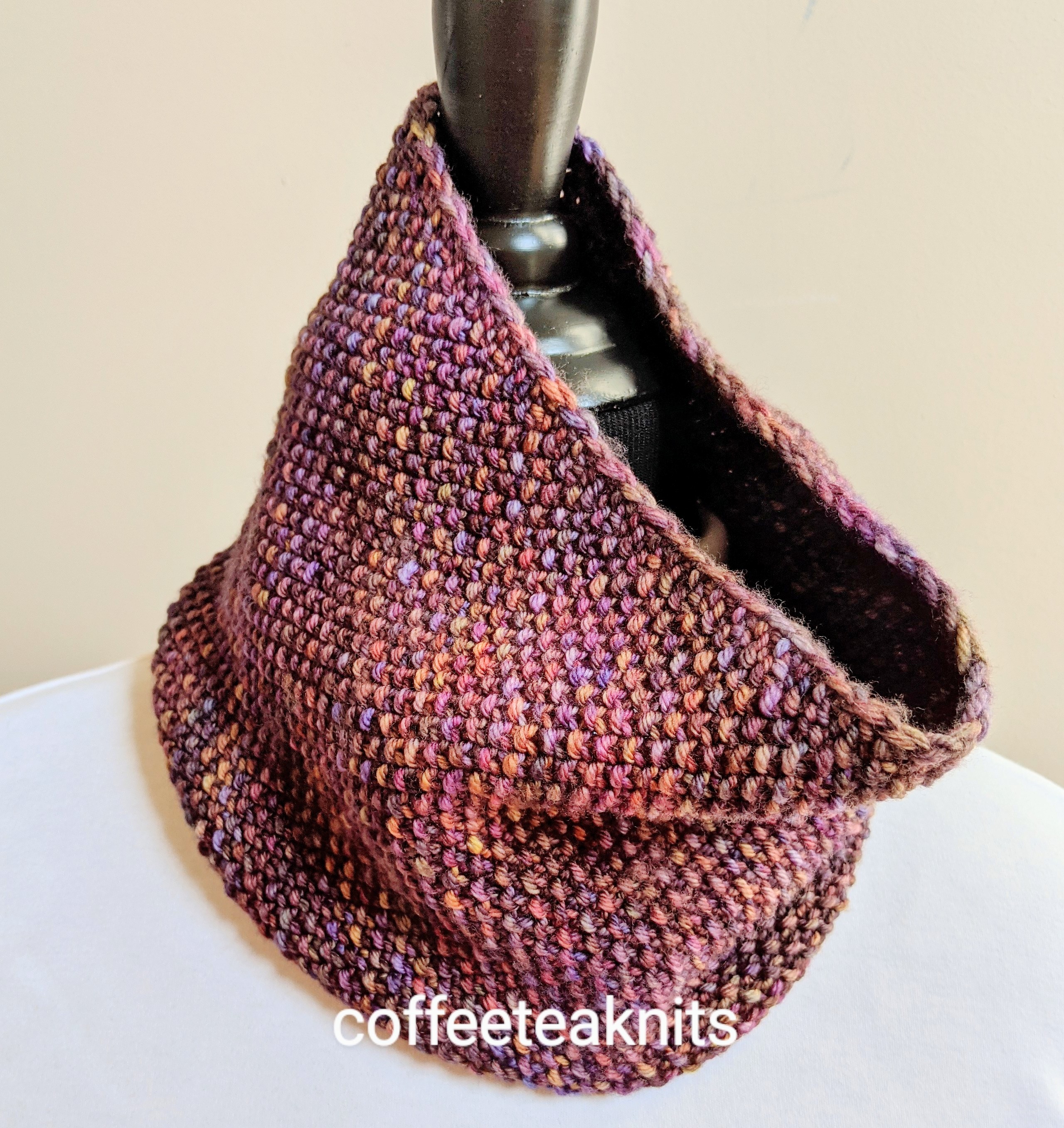
Goes with Everything Earwarmer

Goes with Everything Earwarmer

     This month has been quite overwhelming in terms of snow and icy temperatures. I’ve spent most of the month staying indoors bundled up in sweaters and other knitwear for warmth and of course keeping busy with knitting, weaving or crocheting. I had some of Malabrigo Rios yarn left over from knitting the “Goes with Everything Cowl” last month. There was just enough yarn leftover (about 27 – 28 grams) to knit the Goes with Everything Earwarmer.

            The earwarmers I’ve knit in the past have been knit in the round. I wear them but I’ve found that they tend to curl up in the back when my hair is tied up in a ponytail or a bun. To avoid the earwarmer from curling up in the back, I knit Goes with Everything Earwarmer flat from one side to the other with a series of increases and decreases.
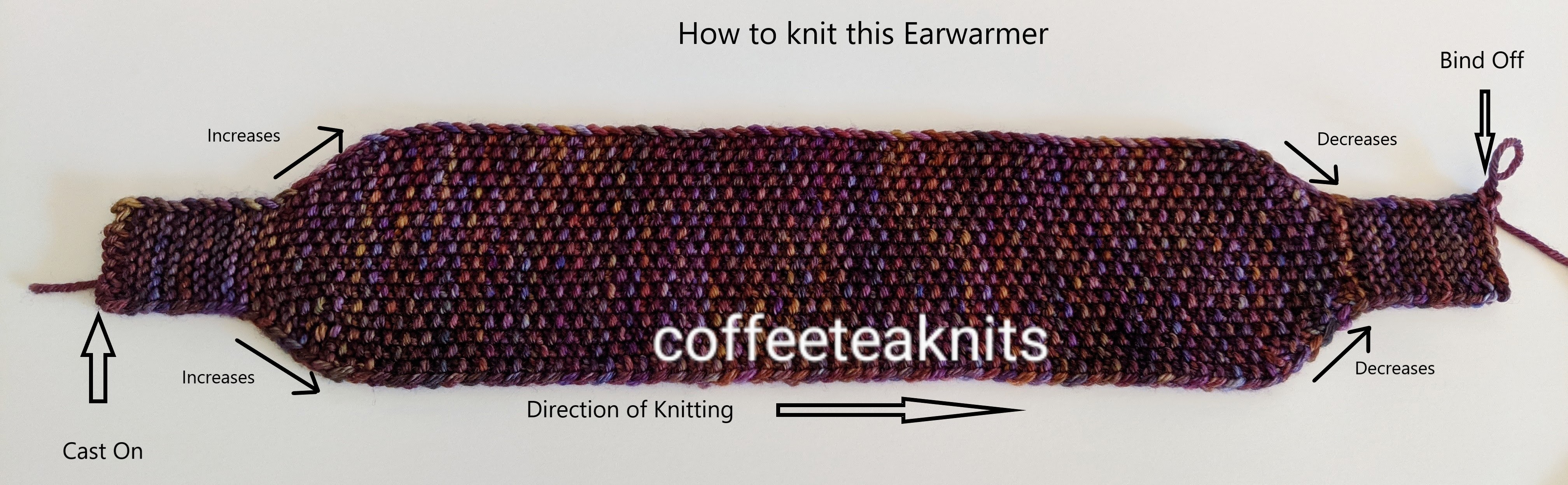
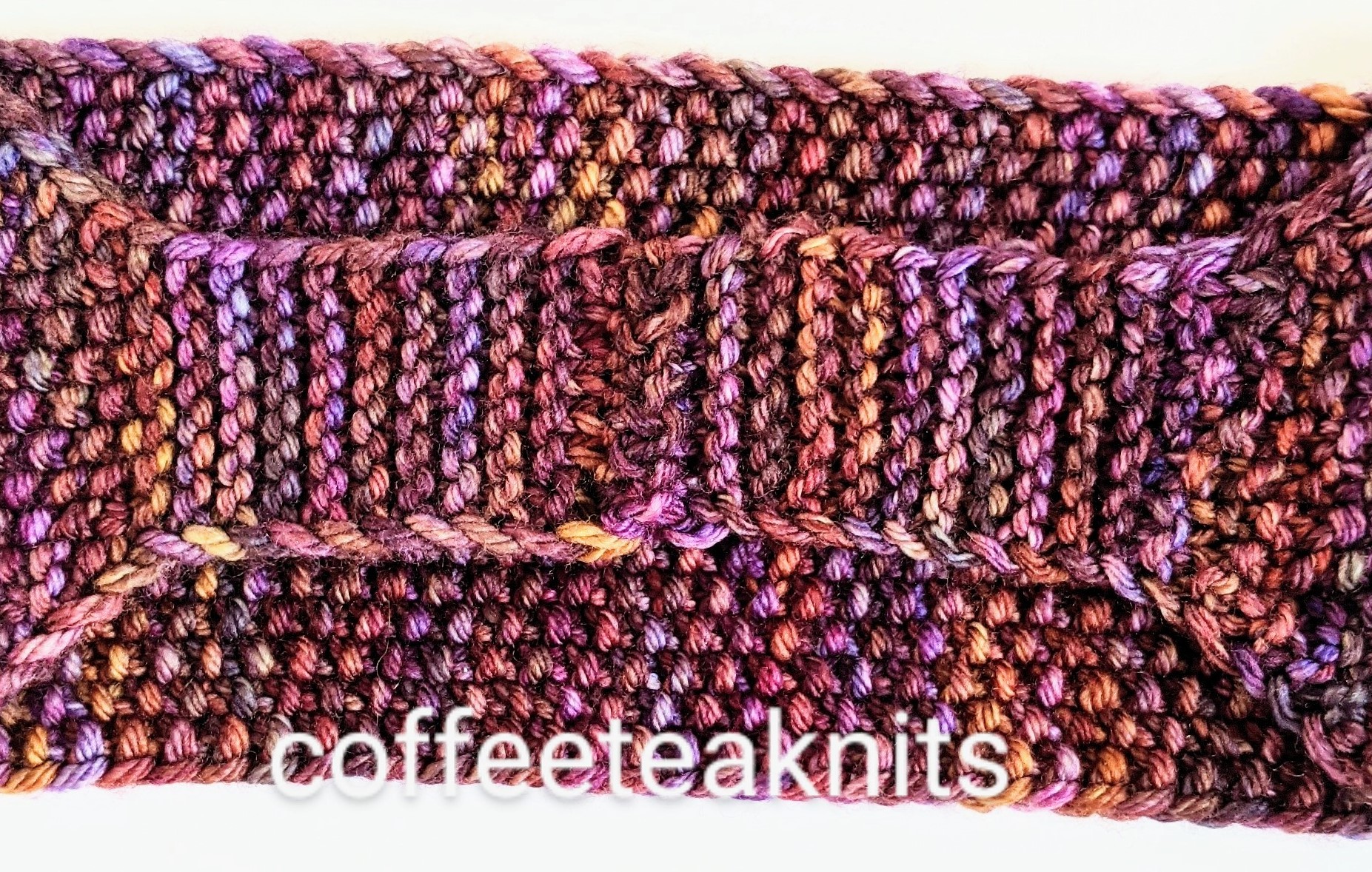
It is first knit in garter stitch pattern for a couple of inches, then increased by 2 stitches every other row for another inch or so (customizable) in seed stitch pattern. The earwarmer is knit straight in seed stitch pattern with no increases or decreases for a specific (customizable) length, and then decreased every other row to the original number of stitches. It is knit again in garter stitch for a couple of inches and then bound off. The two garter stitch sides are joined using the zig zag crochet method.
Goes with Everything Earwarmer Pattern (text and images for personal use only):

Yarn: Malabrigo Yarn – Rios in the RIO877 (Queguay) colorway
Knitting Needles: US #6 and #7 for knitting the earwarmer. US #8 for casting on and binding off.
Crochet hook: US size 7 or 4.5 mm crochet hook
Gauge: 16 stitches/ 4 inches (this pattern is generic so gauge not so critical)
Abbreviations:

  • K: Knit
  • P: Purl
  • Kfb: Knit front and back (knit one stitch first in the front and then knit the same stitch in the back before slipping it off the left needle – 1 stitch increase)
  • K2tog: Knit the first two stitches together on the left needle (1 stitch decrease)
  • pm: place marker
  • rm: remove marker
  • sm: slip marker
  • wyif S1: with yarn in front slip 1 stitch purlwise
  • RS: right side
  • WS: wrong side

The seed stitch pattern:
Row 1 (RS): *K1, P1*; repeat from *…* to end of the row
Row 2 (WS): *P1, K1*; repeat  from *…* to end of the row
*Knit in seed stitch pattern: Knit the purl stitches and purl the knit stitches

With a size US #8 knitting needle cast on 9 stitches start knitting with US #6 knitting needle the following garter stitch pattern:

  • Row1 – Setup row (RS): K1, pm, K7, pm, wyif S1
  • Row2 (WS): K1, sm, K7, sm, wyif S1

Repeat Row 2 – 18 more times (about 2 inches in length)

Increase section (2 stitches increased every other row):
With US #7 needles knit this section in seed stitch pattern

  • Row 1 (RS): K1, sm, Kfb, *knit in seed stitch pattern till 1 stitch before marker, Kfb, sm, wyif S1
  • Row 2 (WS): K1, sm, K1, *knit in seed stitch pattern till 1 stitch before marker, K1, sm, wyif S1

Repeat these two rows 5 more times for a total of 19 stitches (customize to your size by adding or subtracting these row repeats to the length that will cover your ears)

Straight knitting with no increases or decreases section (customize to your size by measuring the number of stitches from one ear to the other and knit about 2 to 4 inches less for negative ease):
Continue in knitting with US #7 knitting needle and seed stitch pattern

  • Row 1 (RS): K1, sm, *K1, P1*; repeat from *…* to 1 stitch before marker, K1, sm, wyif S1
  • Row 2 (WS): K1, sm, K1, *P1, K1*; repeat from *…* till marker, sm, wyif S1

Repeat these two rows till the knitted piece measures about 15 inches from cast on edge (add or subtract row repeats to your specific size)

Decrease section (2 stitches decreased every other row):
With US #7 knitting needle and seed stitch pattern

  • Row 1 (RS): K1, sm, K2tog, *knit in seed stitch pattern till 1 stitch before marker, K2tog, sm, wyif S1
  • Row 2 (WS): K1, sm, K1, *knit in seed stitch pattern till 1 stitch before marker, K1, sm, wyif S1

Repeat these two rows 5 more times decreasing the number of stitches to 9 (if your stitch count was more or less than 19 stitches, add or subtract these row repeats till 9 stitches)

With US #6 knitting needle knit the following garter stitch pattern:

  • Row1(RS): K1, sm, K7, sm, wyif S1
  • Row2 (WS): K1, sm, K7, sm, wyif S1

Repeat these two rows 9 more times (about 2 inches in length). Bind off with US #8 knitting needle and hold the remaining stitch with a removable stitch marker.

Crochet join (optional):

Insert a size 7 or 4.5 mm crochet hook in the remaining stitch, chain one, and align the two sides facing RS of the knitted piece together on the RS. Use the zig zag slip stitch crochet join method to join the two sides together (several online video tutorials are available on YouTube for this crochet join method).

Alternately, the two sides can be joined with any other join method of choice.

Weave in the ends, wash and block the earwarmer.

Stay warm


~coffeeteaknits.com

Goes with Everything Cowl

 Goes  with  Everything  Cowl

Hello fellow knitters and crocheters, welcome to my first blog post of 2021. It’s common to write about one’s knitting and crocheting goals for the year, but I will skip all that. Instead, I will write about how I knitted the Goes with Everything Cowl. I chose this name for the cowl because the yarn colorway seems to go with everything I have in my wardrobe. I purchased this yarn (one skein) a couple of years ago on a wonderful summer vacation trip. This cowl was a quick and simple knit and I’m satisfied with how it turned out. I’ll be wearing it quite a bit during this frigidly cold winter.

The cowl is knitted flat in a rectangle from one corner to another. The two shorter sides of the rectangle are then joined to make a warm and comfortable circular cowl. You begin with casting on one stitch and increase two stitches every other row till the desired width is reached. The cowl is then worked on for the desired length with no net increase. Lastly the cowl is decreased two stitches every other row till one stitch is left on the needle. The shorter sides of the knitted rectangle are then joined together using the zigzag crochet join method.

Goes with Everything Cowl Pattern (text and images for personal use only):
Yarn: Malabrigo Yarn – Rios in the RIO877 (Queguay) colorway
Knitting Needles: US #7
Crochet hook: US size 7 or 4.5 mm crochet hook
Gauge: 16 stitches/ 4 inches (this pattern is generic so gauge not so critical)
Abbreviations:

  • K: Knit
  • P: Purl
  • Kfb: Knit front and back (knit one stitch first in the front and then knit the same stitch in the back before slipping it off the left needle – 1 stitch increase)
  • K2tog: Knit the first two stitches together on the left needle (1 stitch decrease)
  • pm: place marker
  • rm: remove marker
  • sm: slip marker
  • wyif: with yarn in front
  • RS: right side
  • WS: wrong side

The seed stitch pattern:
Row 1 (RS): *K1, P1*; repeat from *…* to end of the row
Row 2 (WS): *P1, K1*; repeat  from *…* to end of the row
*Knit in seed stitch pattern: Knit the purl stitches and purl the knit stitches

With a size US #7 knitting needle cast on 1 stitch with this yarn

Increase Rows:

  • Row 1 (RS): Kfb and turn to the WS row
  • Row 2 (WS): K2
  • Row 3 (RS): Kfb, Kfb
  • Row 4 (WS): K1, pm, K2, pm, wyif S1
  • Row 5 (RS): K1, sm, Kfb, Kfb, sm, wyif S1. Place a removable stitch marker for the RS row.
  • Row 6 (WS): K1, sm, K1, P1, K2, sm, wyif S1
  • Row 7 (RS): K1, sm, Kfb, K1, P1, Kfb, sm, wyif S1
  • Row 8 (WS): K1, sm, K1, [K1, P1] 2x, K1, sm, wyif S1
  • Row 9 (RS): K1, sm, Kfb, [knit in seed stitch pattern*] till 1 stitch before marker, Kfb, sm, wyif S1
  • Row 10 (WS): K1, sm, K1, [knit in seed stitch pattern*] till 1 stitch before marker, K1, wyif S1

Repeat rows 9 and 10 till the number of stitches for the preferred cowl width is reached. The width for this cowl is about 7.5 inches.

Length increase Rows:

  • Row 1 (RS): K1, sm, Kfb, [knit in seed stitch pattern*] till 2 stitches before marker, K2tog, sm, wyif S1
  • Row 2 (WS): K1, sm, K1, [knit in seed stitch pattern*] till 1 stitch before marker, K1, sm, wyif S1

Repeat these two rows till desired length is reached. The length for this cowl is about 19.5 inches.

Decrease Rows:

  • Row 1 (RS): K1, sm, K2tog, [knit in seed stitch pattern*] till 2 stitches before marker, K2tog, sm, wyif S1
  • Row 2 (WS): K1, sm, K1, [knit in seed stitch pattern*] till 1 stitch before marker, K1, sm, wyif  S1

Repeat Rows 1 and 2 till 6 stitches left on the needle ending on the WS row

  • RS row: K1, sm, K2tog, K2tog, sm, wyif S1
  • WS row: K1, rm, K2, rm, wyif S1 (do not remove the RS removable marker)
  • RS row: K2tog, K2tog
  • WS row: Bind off (hold the remaining stitch with a removable stitch marker)

Crochet join (optional):

Insert a size 7 or 4.5 mm crochet hook in the remaining stitch, remove the stitch marker, chain one, and align the two shorter sides of the knitted rectangle together on the RS. Use the zigzag crochet join method to join the two sides together (several online video tutorials are available for this crochet join method).

Alternately, the two sides can be joined with any other join method of choice.

Weave in the ends, wash and block cowl.


Stay warm and stay safe


~coffeeteaknits.com

A Corner to Corner Dishcloth

Corner to Corner Dishcloth

Corner to Corner Dishcloth

Corner to corner knitting is another technique that can be used to knit square dishcloths, blankets etc. I like this technique because it’s worked flat and starts with a cast on of just 1 stitch. That 1 stitch through a series of increases and decreases ends in a square dishcloth or a blanket. The dishcloth pattern below is my version of the corner to corner knitting technique using the seed stitch pattern.

The Corner to Corner Dishcloth Pattern (text and images for personal use only):

Yarn: Lily Sugar’n Cream in Colorways: Potpourri Ombre and Country Red
Knitting Needles: US #7
Crochet hook: US size 7 or 4.5 mm crochet hook
Gauge: Not needed for this project
Abbreviations:

  • K: Knit
  • P: Purl
  • Kfb: Knit front and back (knit one stitch first in the front and then knit the same stitch in the back before slipping it off the left needle – 1 stitch increase) 
  • K2tog: Knit the first two stitches together on the left needle (1 stitch decrease)
  • ssk: slip slip knit (slip 2 stitches to right hand needle then insert the left needle in front of the two slipped stitches and knit them together)
  • pm: place marker
  • rm: remove marker
  • sm: slip marker
  • wyif: with yarn in front
  • RS: right side
  • WS: wrong side

The seed stitch pattern:
Row 1 (RS): *K1, P1*; repeat from *…* to end of the row
Row 2 (WS): *P1, K1*; repeat  from *…* to end of the row
*Knit in seed stitch pattern: Knit the purl stitches and purl the knit stitches

With a size US #7 knitting needle cast on 1 stitch with the Potpourri Ombre colorway.

Increase Rows:

  • Row 1 (RS): Kfb and turn to the WS row
  • Row 2 (WS): K2
  • Row 3 (RS): Kfb, Kfb
  • Row 4 (WS): K1, pm, K2, pm, wyif S1
  • Row 5 (RS): K1, sm, Kfb, Kfb, sm, wyif S1. Place a removable stitch marker for the RS row. 
  • Row 6 (WS): K1, sm, K1, P1, K2, sm, wyif S1
  • Row 7 (RS): K1, sm, Kfb, K1, P1, Kfb, sm, wyif S1
  • Row 8 (WS): K1, sm, K1, [K1, P1] 2x, K1, sm, wyif S1
  • Row 9 (RS): K1, sm, Kfb, [knit in seed stitch pattern*] till 1 stitch before marker, Kfb, sm, wyif S1
  • Row (WS): K1, sm, K1, [knit in seed stitch pattern] till 1 stitch before marker, K1, wyif S1

Repeat rows 9 and 10 till the number of stitches for the preferred dishcloth size is reached.

Transition Rows:

  • Row 1 (RS): K1, sm, K1, [knit in seed stitch pattern] till 1 stitch before marker, K1, sm, wyif S1
  • Row 2 (WS): K1, sm, K1, [knit in seed stitch pattern] till 1 stitch before marker, K1, sm, wyif S1

Decrease Rows:

  • Row 1 (RS): K1, sm, K2tog, [knit in seed stitch pattern] till 2 stitches before marker, ssk, sm, wyif S1
  • Row 2 (WS): K1, sm, K1, [knit in seed stitch pattern] till 1 stitch before marker, K1, sm, wyif  S1
  • Repeat Rows 1 and 2 till 6 stitches left on the needle on the WS row
  • RS row: K1, sm, K2tog, ssk, sm, wyif S1
  • WS row: K1, rm, K2, rm, wyif S1
  • RS row: K2tog, ssk
  • WS row: Bind off

Wash and block dishcloth.

Crochet a single crochet border edging around the dishcloth in the Country Red colorway with a Size 7 or 4.5 mm crochet hook.

Weave in the ends.


~coffeeteaknits.com

To knit a center out blanket

A center out knit blanket


Yarn used: Lion Brand Pound of Love® Yarn


This garter stitch blanket is knit center out with two different colors of yarn I already had. Compared to the center out crochet blanket I posted about in February 2020 which was completed within two months, knitting this blanket has taken me longer than six months to complete. This is because as the blanket grew larger, I could only knit a few rounds in one sitting due to issues with hand fatigue. There were close to 800 stitches on the needle at bind off. 

The number of garter ridge stripes for are based on the Fibonacci sequence till the last stripe for both yarn colors. I did not have enough yarn left so the number of garter ridges for the last stripes are shorter than the next Fibonacci number in the sequence. The blanket was finished with a single crochet border and diagonal crochet duplicate stitches for the four corners. Although I like how the center out seamless knit blanket looks, I still find the process of crocheting a center out seamless blanket more appealing. 


~coffeeteaknits.com

To knit during a pandemic

Four years ago my May 2016 blog post was about “The Simple Elegance of the Garter Stitch” and how with this stitch pattern we can create several beautiful and elegant knits. This year amidst the stay-at-home order due to the coronavirus pandemic, I would like to add that I’ve also found knitting with the garter stitch pattern both meditative and comforting.

A Garter Stitch Wrap

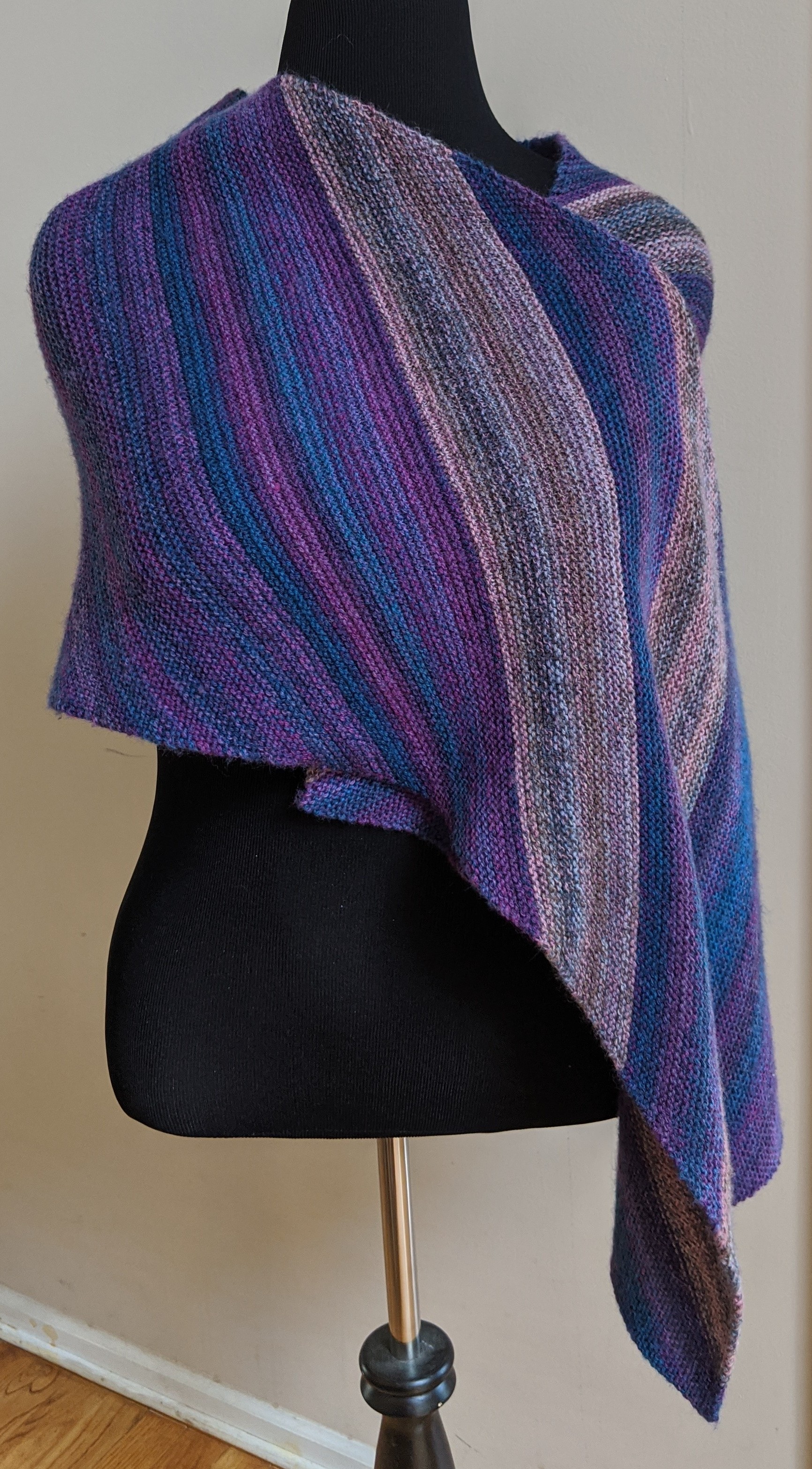
I used the Zaden Spring Shawl pattern by Staci Perry of Very Pink Knits as inspiration and also to learn the bias knitting technique for a wrap. I modified the pattern by using a different stitch count, sock yarn, and knit the wrap using just the garter stitch pattern. 

May knitting bring you comfort!


~coffeeteaknits.com