Tutorial Series: The Thumb Method Cast-on

The Thumb method cast-on is a commonly used long tail cast-on technique. A long tail of yarn is set aside on one side of the slip knot. The working yarn is on the other side of the slip knot. The thumb is used to form the loop that is used to make a new stitch on the knitting needle. Another example of a long tail cast-on technique is the slingshot method. In this method, the thumb and the index finger create a new stitch. The thumb method is beginner-friendly and a quick cast-on method. I use the thumb method cast-on mostly for knitting projects with few stitches (dishcloths, etc.). The written instructions and video below on how to do the thumb method cast-on are shown for right-handed knitting.

The Thumb Method Cast-On:


The Steps for the Thumb Method Cast-On:

  1. Make a slip knot (Tutorial Series: How to Slip Knot) with a yarn tail that will be enough for the number of stitches for a specific knitting project
  2. Insert the slip knot onto a knitting needle
  3. Holding the yarn tail with some tension in the left fist, wrap the left thumb under and over the yarn tail to make a loop
  4. Insert the right hand needle into the front strand of the loop on the thumb
  5. Bring the working yarn around the top of the right needle and wrap it between the thumb and the right knitting needle
  6. Catch and pick up the working yarn loop (a new stitch) with the right needle
  7. Repeat Steps 3 – 6 to cast-on the required number of stitches needed for a knitting project

~coffeeteaknits.com

Tutorial Series: The Knotted K2tog Bind Off

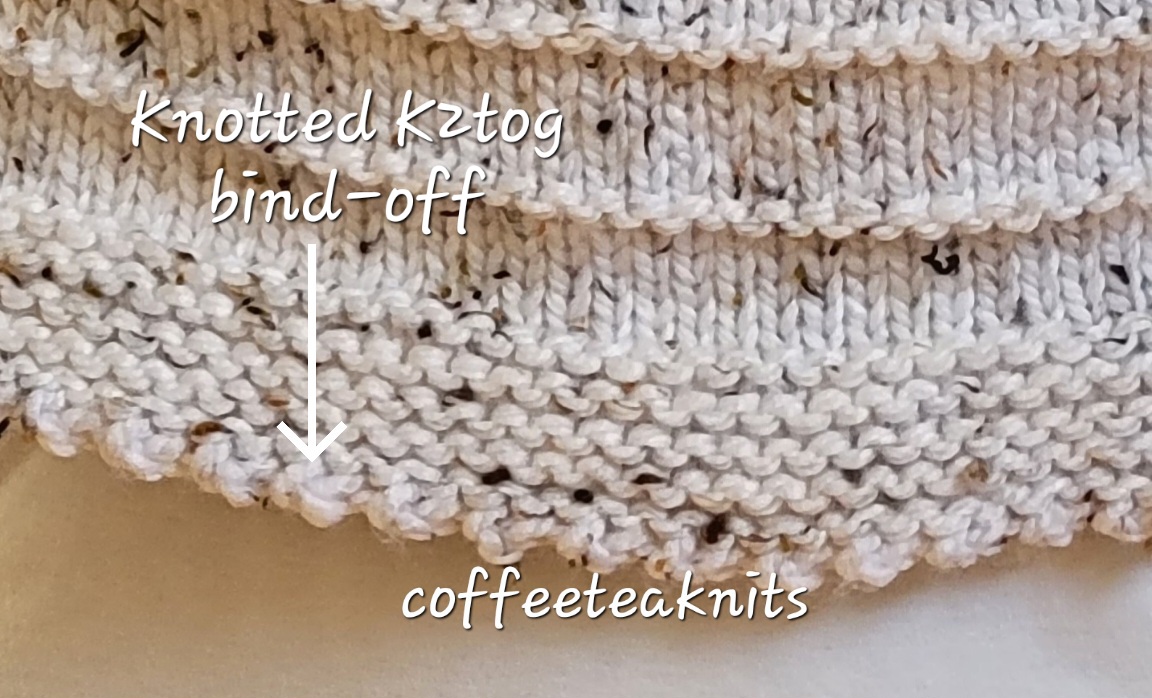
A decorative bind – off method that I used in The Cozy Season Shrug is the Knotted K2tog bind – off. It gives a nicer looking finished edge for shawls, shrugs etc. that can be added to a garter stitch pattern border.

The written instructions and video below on how to do the knotted K2tog bind – off is shown for right handed knitting.

Abbreviations:

  • K: Knit
  • K2tog: Knit the two stitches on the left knitting needle together
  • wyif: with the working yarn in front

The Knotted K2tog Bind Off:

Knotted K2tog Bind Off: (written intructions)

  1. To begin the bind off row/round: K2, wyif slip the 2 knitted stitches on the right knitting needle back onto the left knitting needle
  2. Wrap the working yarn in front of the 2 stitches on the left knitting needle
  3. Insert the right knitting needle into the wrapped stitches on the left knitting needle and knit those 2 stitches together.
  4. Knit the next stitch on the left knitting needle. There are two stitches on the right knitting needle
  5. Pass the second stitch on the right knitting needle over the first stitch on that needle
  6. K1, wyif slip the 2 knitted stitches on the right knitting needle back onto the left knitting needle
  7. Repeat steps 2 to 5
  8. Repeat steps 6 and 7 till one stitch left in the bind off row/round
  9. Cut and pull working yarn through the last remaining stitch and weave in the end

~coffeeteaknits.com

Tutorial Series: Pfb (Purl front and back)

Purl front and back (Pfb) is the method to increase stitches on the purl side in a row or round. One stitch in a row or round is added when the first stitch on the left knitting needle is purled in the front loop as well as in the back loop before sliding that stitch off the left needle. The written instructions and video below show how to increase stitches by doing a Pfb for right handed knitting.

Abbreviations:

  • P: purl
  • Pfb: purl front and back

Pfb (Purl front and back) in slow motion:

.

Pfb (Purl front and back) written instructions:

  • With working yarn in front, insert the right knitting needle from front to back into the front loop of the first stitch on the left knitting needle
  • Bring the working yarn around and between the left and right knitting needles
  • With the right needle, catch and pull the loop made by the working yarn under the front loop of the stitch on the left needle
  • Turn the right needle towards the back loop of the same stitch on the left needle
  • Insert the right needle from back to front into the back loop of the same first stitch on the left needle
  • Bring the working yarn around and between the two needles
  • Catch and pull the new loop made by the working yarn with the right needle
  • Slide the first stitch off the left needle and secure the two new stitches on the right needle

P1, Pfb, P1, Pfb:


~coffeeteaknits.com

Tutorial Series: (Kfb) Knit front and back

One way to increase stitches in knitting is the Kfb (knit front and back) method. Increasing stitches in knitting is used to give shape to knitted items, for texture and for lace work. An extra stitch is added in a row or round when a stitch on the left knitting needle is knit both in the front loop as well as in the back loop. This tutorial includes written instructions and two videos (one in slow motion) on how to increase stitches by doing a Kfb for right handed knitting.

Advertisements

Kfb in Slow Motion:

Advertisements

Written Instructions for Kfb (Knit front and back):

  • Insert the right knitting needle into the front loop of the first stitch on the left knitting needle
  • Bring the working yarn around and between the left and right knitting needles
  • Catch and pull the loop made by the working yarn with the right needle
  • Turn the right needle towards the back loop of the same stitch on the left needle
  • Insert the right needle into the back loop of that stitch
  • Bring the working yarn around and between the two needles
  • Catch and pull the new loop made by the working yarn with the right needle
  • Slide the first stitch off the left needle and secure the two new stitches on the right needle

The video below shows Knit 1, KFB, Knit 1, Kfb:

Advertisements

~coffeeteaknits.com

Tutorial Series: K2tog and P2tog

One way to decrease a stitch in knitting is by doing a K2tog on the knit row/round or a P2tog on a purl row/round. K2tog stands for knit two stitches together and P2tog stands for purl two stitches together. The videos below show both ways of decreasing one stitch in right handed knitting.

Advertisements

Written Steps for K2tog:

  • Insert the right needle into the front of the second stitch on the left knitting needle and then insert it into the first stitch on the left needle
  • Wrap the working yarn around the inserted right needle
  • Pull the right knitting needle and working yarn loop into and through the 2 stitches on the left needle
  • Keep the working yarn loop (the new stitch) on the right needle and slide the 2 stitches off the left needle
Advertisements
Advertisements

Written Steps for P2tog:

  • Insert right needle front to back into the first two stitches on the left knitting needle
  • Wrap the working yarn around the right needle
  • Pull the working yarn loop on the right needle through the two stitches on the left needle and keep the loop (new stitch) on the right needle
  • Slide the first two stitches off the left needle
Advertisements
Advertisements

~coffeeteaknits.com